
Annual Site
Environmental Report
Each year, Idaho National Laboratory (INL) prepares an Annual Site Environmental Report (ASER) in compliance with DOE Order 231.1B, Environment, Safety, and Health Reporting, as required by the U.S. Department of Energy (DOE). This report is prepared to inform the public, regulators, stakeholders, and other interested parties about INL’s environmental performance. It summarizes environmental data, the performance of the environmental management system, and INL’s compliance with applicable DOE, federal, state, and local regulations.
Environmental monitoring has been conducted at the INL Site since 1951.
The ASER is published by October 1 each year for the preceding calendar year. The latest reports are available in PDF format. Please note that these files are large and may take some time to download.
Each year, Battelle Energy Alliance prepares an Idaho National Laboratory (INL) Annual Site Environmental Report (ASER) in accordance with U.S. Department of Energy (DOE) Office of Nuclear Energy Order 231.1, “Environment, Safety, and Health Reporting.” The ASER provides the public, regulators, stakeholders and other interested parties with a clear summary of INL’s environmental performance, including key results from environmental monitoring conducted to comply with federal and state requirements. In keeping with DOE Idaho Operations Office guidance, the ASER presents only the monitoring results that exceed established reporting limits rather than listing every analytical value (including those below reporting limits). This practice ensures the information remains meaningful and accessible.
Why this change is being made:
Enhancing clarity and accessibility
To improve usability and avoid repetition with other official environmental reports and platforms, BEA is now streamlining the ASER format, starting with the report for 2026. This concise report continues to provide clear, meaningful information to help the public understand environmental monitoring at the INL Site.
This update reflects INL’s commitment to:
- Reducing redundancy by removing content already published elsewhere.
- Simplifying to create a clear, more focused summary of environmental conditions while still providing the key information needed to evaluate INL’s performance.
- Making environmental information easier for the public to interpret by focusing only on results above reporting limits rather than listing every analytical value.
The new format centers on four key questions:
- What was sampled?
- Were detections observed?
- Are there trends?
- What does it mean for you?
By framing the report around these questions, the ASER provides straightforward insights into INL’s environmental surveillance and compliance monitoring programs.
Accessing the report
The ASER is published annually by Oct. 1 for the preceding calendar year. The latest reports are available as downloadable PDF files, which may take additional time to download due to their size.
INL Environmental Performance


Helpful Resources
INL Site History
Helpful Information
Glossary
Quarterly Reports (2000 - 2024)
The INL environmental surveillance program documents the monitoring results for the public in quarterly reports. These reports document the results for the environmental media sampled on the INL Site, boundary and off-site locations. Quarterly reports were developed to provide early notice to the public of radioactive and nonradioactive hazardous constituents in amounts above regulatory limits. The quarterly reports are then combined and into the Annual Site Environmental Report. The surveillance quarterly reports date back to the early 1960s.
Quarterly Environmental Surveillance Reports are published and summarized in the INL’s Annual Site Environmental Report (ASER) to comply with DOE Order 231.1B, Environment, Safety, and Health Reporting, as mandated by the U.S. Department of Energy (DOE).
Quarterly reports are issued several months after the end of each quarter to allow contracted analytical laboratories time to process samples and prepare the findings. The INL contractor then evaluates these findings to identify trends and compare them with DOE Derived Concentration Standards.
2025 Idaho National Laboratory Annual Site Environmental Report
The 2025 Idaho National Laboratory Annual Site Environmental Report is an overview of environmental management activities conducted on and in the vicinity of the INL Site from Jan. 1 through Dec. 31, 2025.
This report includes:
- Effluent monitoring and environmental surveillance of air, water, vegetation, biota and agricultural products for radioactivity. The results are compared with historical data, background measurements and/or applicable standards and requirements in order to verify that the INL Site does not adversely impact the environment or the health of humans or biota.
2025 Idaho National Laboratory Annual Site Environmental Report
The 2025 INL ASER provides an overview of surveillance and compliance monitoring conducted on and around the INL Site from Jan. 1 through Dec. 31, 2025. The report summarizes monitoring results and compares them with historical data, background measurements, and applicable regulatory standards to verify that INL Site operations do not adversely impact the environment or the health of people or wildlife.
2025 Annual Site Environmental Report Chapters and Supplemental Reports
DOE/ID-12082 (25), INL/RPT-26-92546, Rev 0
2025 Report Chapters:
Executive Summary and Helpful Information
Chapter 1 – Overview of the INL Site
Chapter 2 – Environmental Monitoring Programs – Air
Chapter 3 – Environmental Management Programs – Liquid Effluents Monitoring
Chapter 4 – Environmental Monitoring Programs – Eastern Snake River Plain Aquifer Monitoring
Chapter 6 – Dose to the Public
2025 Supplemental Reports:
- Meteorological Monitoring
- Statistical Methods Used in the Idaho National Laboratory Annual Site Environmental Report
2025 Technical Reports:
- DOSEMM_A Model for Assessment of Airborne Releases and Multimedia Terrestrial Transport and Dose Assessment
- Total Effective Dose from INL Airborne Releases
- National Emission Standards for Hazardous Air Pollutants Analysis, Methodology, and Results for Radionuclides
Advanced Test Reactor
- 2025 ATR Complex Cold Waste Ponds
- 2025 Groundwater Radiological Monitoring Results Associated with the ATR Complex Cold Waste Ponds
Materials and Fuels Complex
- 2025 Groundwater Radiological Monitoring Results Associated with the MFC Industrial Waste Pond
- 2025 Annual Industrial Wastewater Reuse Report for the Idaho National Laboratory Site’s MFC Industrial Waste Pond
Figure/Table Links
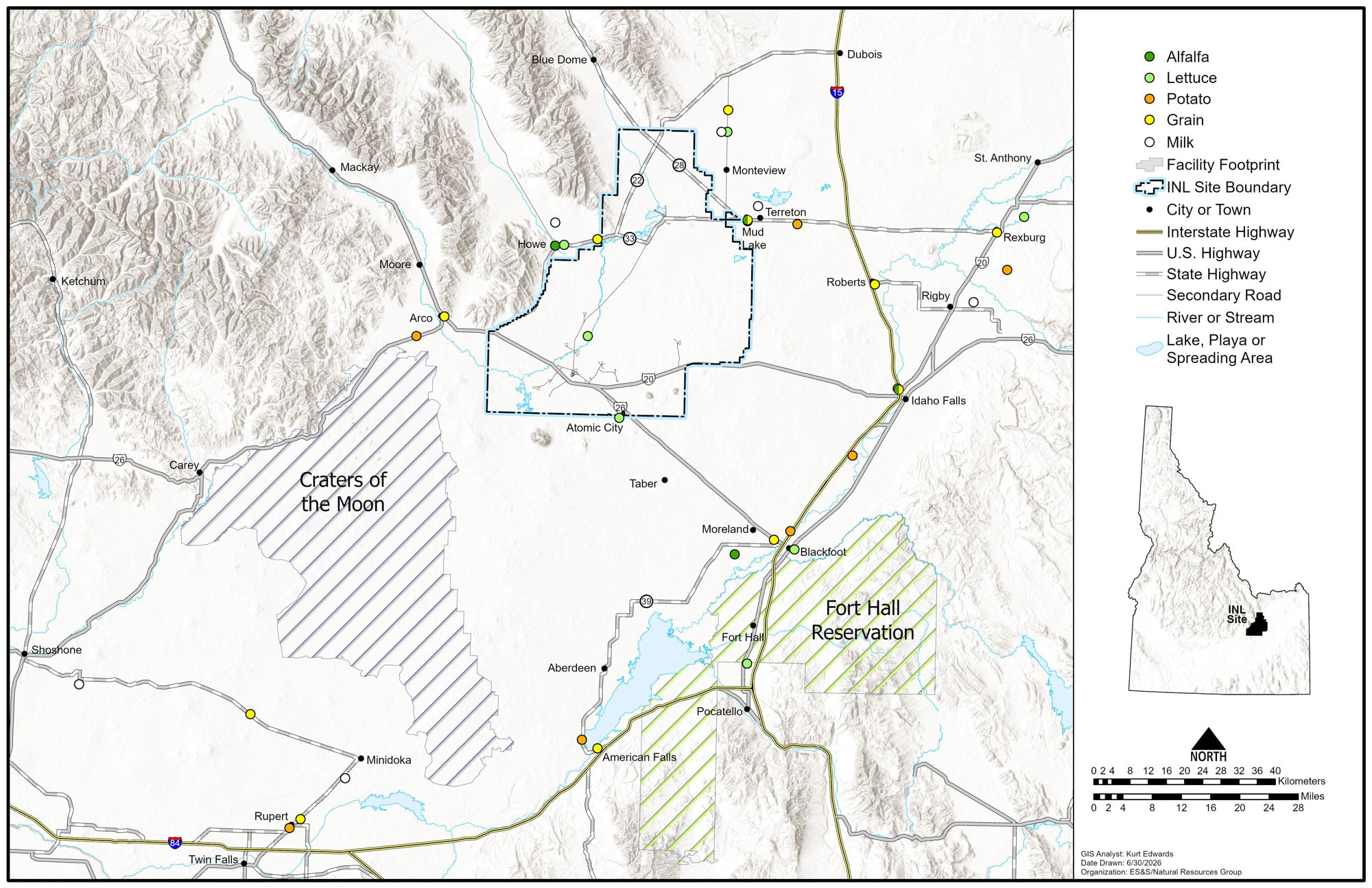
Agricultural Products Monitoring
Air Monitoring/NESHAPS
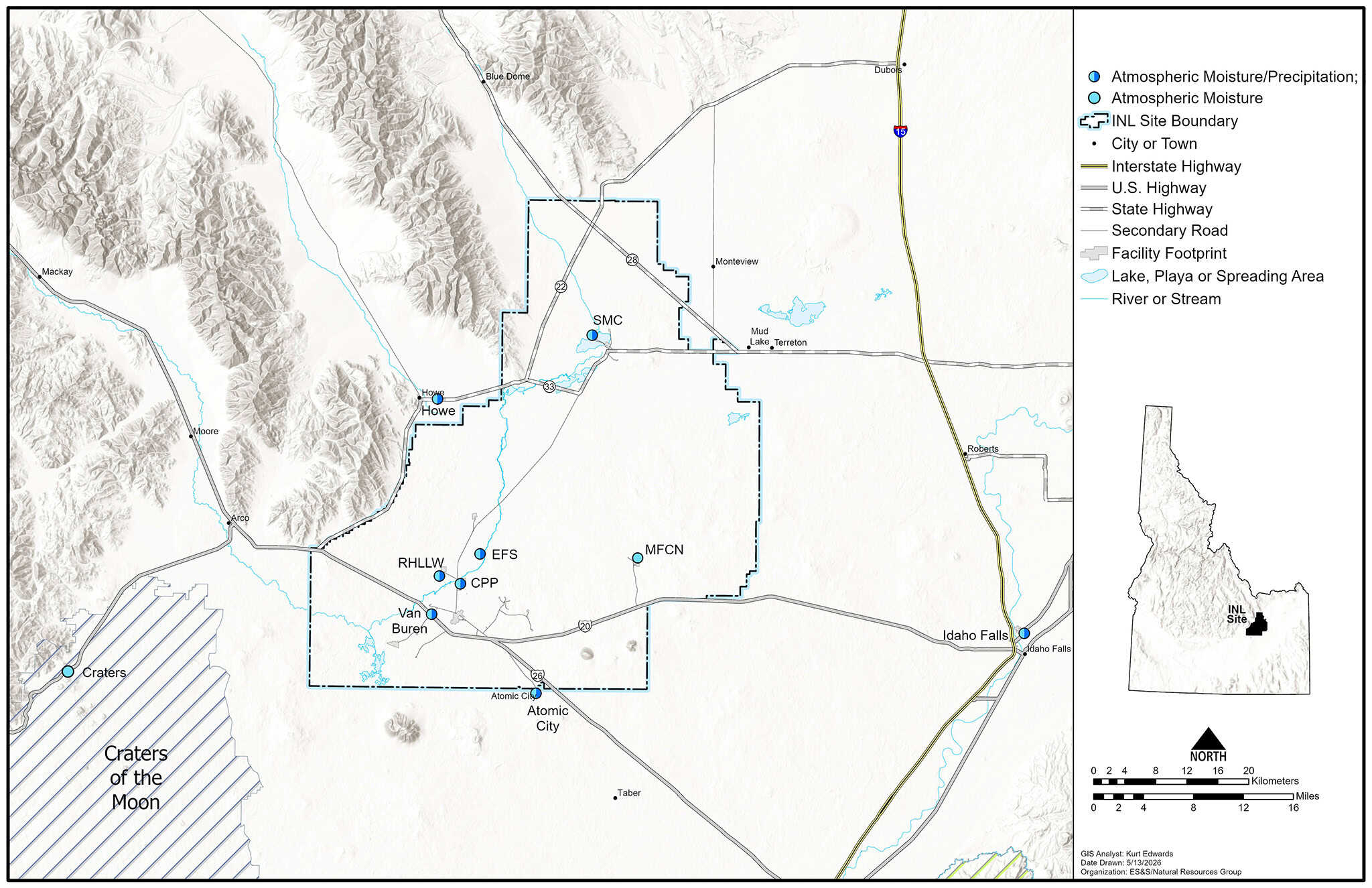
- Atmospheric moisture and precipitation (2025) (INL contractor)
- Environmental Surveillance Air Sampling Locations (INL and ICP contractors)
- INL Site contractors regional ambient air surveillance monitoring activities
Annual Dose
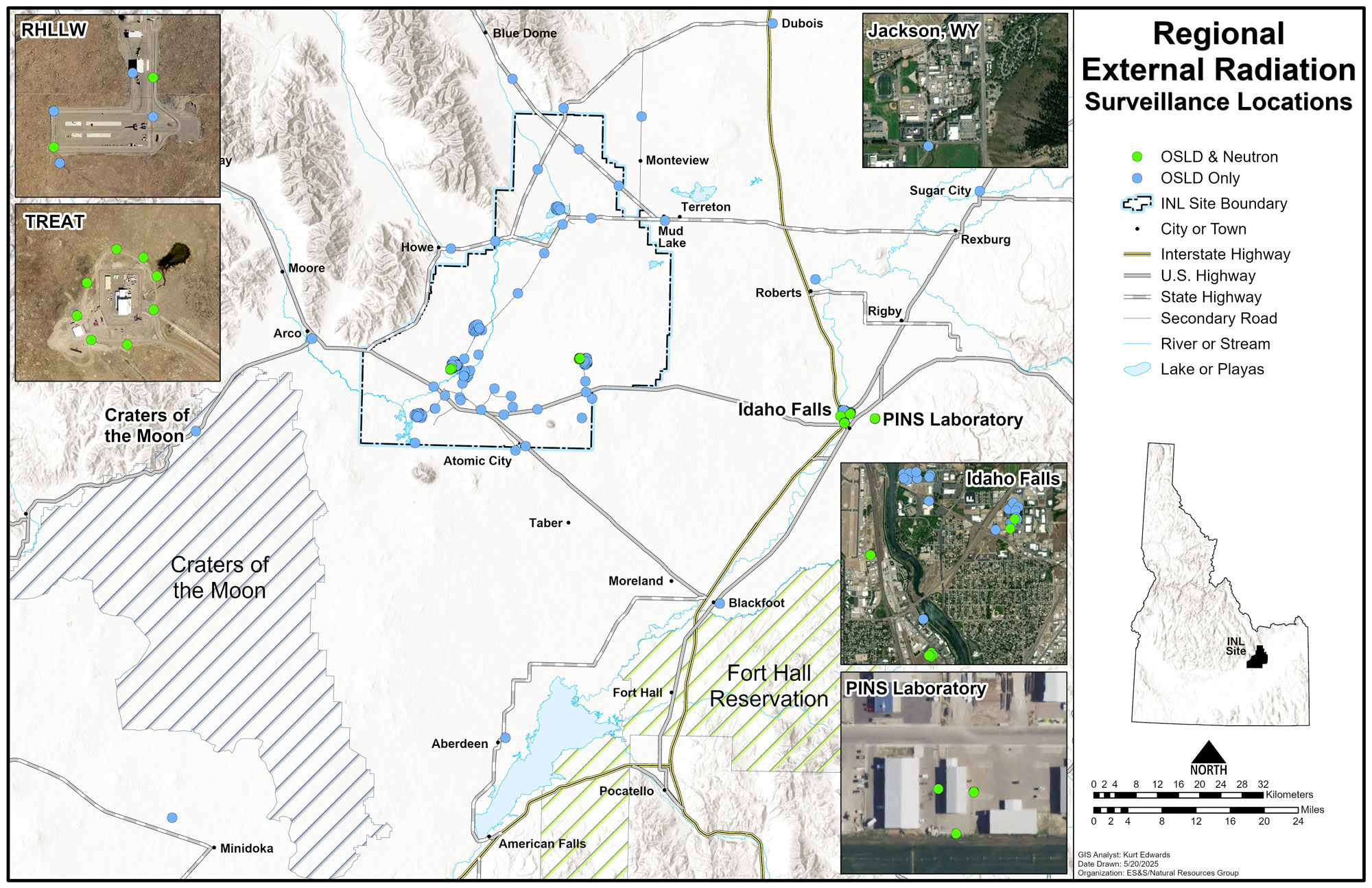
Environmental Direct Radiation Monitoring
Groundwater Monitoring
INL Overview
2025 Annual Site Environmental Report Chapters and Supplemental Reports
2025 Supplemental Reports:
- Meteorological Monitoring
- Statistical Methods Used in the Idaho National Laboratory Annual Site Environmental Report
2025 Technical Reports:
- DOSEMM_A Model for Assessment of Airborne Releases and Multimedia Terrestrial Transport and Dose Assessment
- Total Effective Dose from INL Airborne Releases
- National Emission Standards for Hazardous Air Pollutants Analysis, Methodology, and Results for Radionuclides
Advanced Test Reactor
- 2025 ATR Complex Cold Waste Ponds
- 2025 Groundwater Radiological Monitoring Results Associated with the ATR Complex Cold Waste Ponds
Materials and Fuels Complex
- 2025 Groundwater Radiological Monitoring Results Associated with the MFC Industrial Waste Pond
- 2025 Annual Industrial Wastewater Reuse Report for the Idaho National Laboratory Site’s MFC Industrial Waste Pond
Figure/Table Links
Agricultural Products Monitoring
Air Monitoring/NESHAPS
- Atmospheric moisture and precipitation (2025) (INL contractor)
- Environmental Surveillance Air Sampling Locations (INL and ICP contractors)
- INL Site contractors regional ambient air surveillance monitoring activities
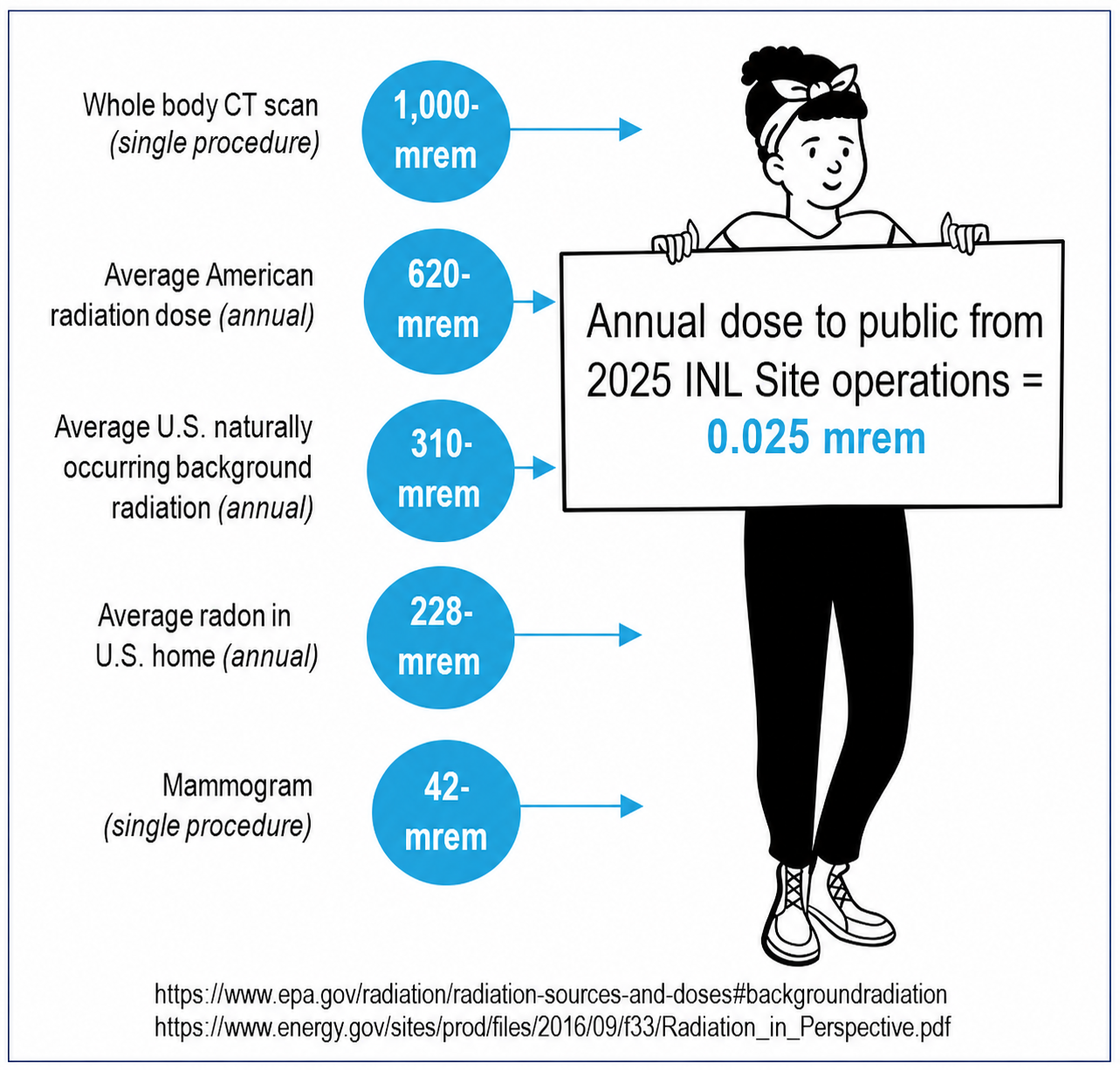
Annual Dose
Environmental Direct Radiation Monitoring
Groundwater Monitoring
INL Overview
2024 Annual Site Environmental Report Chapters and Supplemental Reports
DOE/ID-12082 (24), ISSN 1089-5469, INL/RPT-2584431, Rev 0
2024 Report Chapters:
Executive Summary and Helpful Information
Chapter 2 – Environmental Compliance Summary
Chapter 3 – Environmental Management System
Chapter 4 – Environmental Monitoring Programs: Air
Chapter 5 – Environmental Monitoring Programs: Liquid Effluents
Chapter 6 – Environmental Monitoring Programs: Eastern Snake River Plain Aquifer
Chapter 8 – Dose to the Public and Biota
Chapter 9 – Natural and Cultural Resources Conservation and Monitoring
Chapter 10 – Quality Assurance of Environmental Surveillance Programs
Appendix A – Chapter 5 Addendum
2024 Supplemental Reports:
Statistical Methods Used in the Idaho National Laboratory Annual Site Environmental Report
2024 Technical Reports:
Appendix B: Verification Benchmark Problem
National Emission Standards for Hazardous Air Pollutants
2024 Quarterly Environmental Reports:
Figure/Table Links
Agricultural Products Monitoring
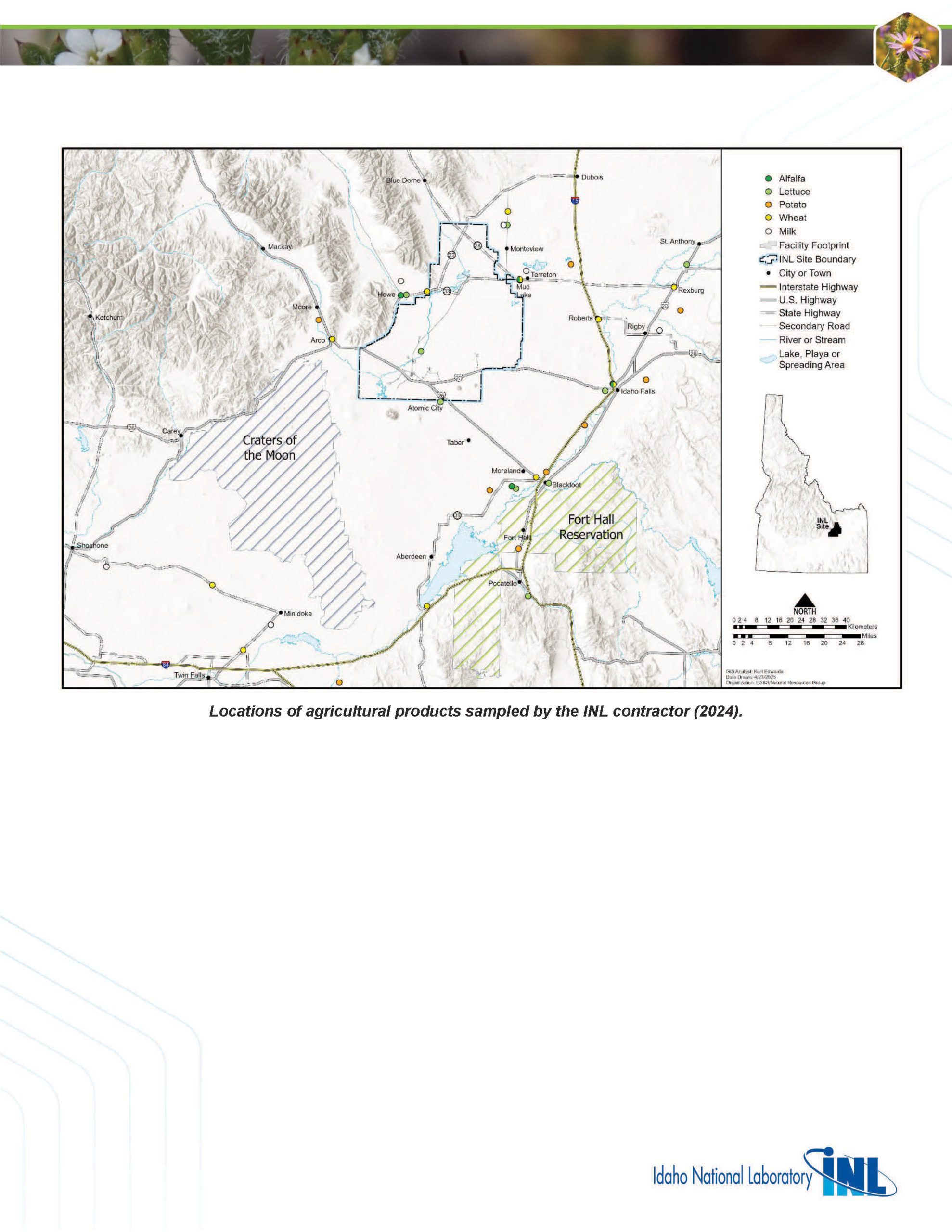
- Locations of agricultural samples collected by the INL contractor (INL contractor)
- Agricultural products, wildlife, soil, direct radiation monitoring by INL Site contractors (INL and Idaho Cleanup Project Contractor)
- Portable lettuce sampler planter photo (INL contractor)
Air Monitoring/NESHAPS
- Air filter heads (left photo). Charcoal cartridge (right photo).
- Atmospheric moisture and precipitation (2024) (INL contractor)
- Atmospheric moisture collection columns
- INL REC source and receptor locations
- INL Site contractors and their regional ambient air surveillance monitoring activities in 2024
- INL Site contractors’ environmental surveillance air sampling locations (INL and Idaho Cleanup Project contractors)
- INL Site conceptual model showing potential routes of exposure/pathways for potential releases
- INL Site major facility airborne source locations
- Location of INL contractor high-volume air samplers at NOAA weather stations (INL contractor)
- Locations of ICP contractor low-volume air samplers at waste management areas sites. (Idaho Cleanup Project contractor)
- Hydrofluorocarbons Phasedown Schedule (OE-3 2021-06)
- Region within 80 km of the INL Site facilities
Effluent Groundwater Monitoring
- INTEC wastewater monitoring for reuse permit (Idaho Cleanup Project contractor)
- Permit monitoring locations for ATR Complex Cold Waste Pond (INL contractor)
- Reuse permit groundwater monitoring locations for INTEC Percolation Ponds (Idaho Cleanup Project contractor)
- Surface water monitoring location at the RWMC SDA (Idaho Cleanup Project contractor)
- Wastewater and groundwater monitoring locations at MFC (INL contractor)
Environmental Direct Radiation Monitoring
Groundwater Monitoring
- EPA final PFAS MCLGs and MCLS
- ICP drinking water sampling summary (2024) (Idaho Cleanup contractor)
- INL drinking water and surface water sampling summary (INL contractor)
- Map of the INL Site showing locations of facilities and corresponding Waste Area Groups
- Groundwater monitoring locations for RHLLW Facility (INL contractor)
- USGS groundwater monitoring locations on and off the INL Site (U.S. Geological Survey)
- USGS monitoring program summary (2024) (US Geological Survey)
- Locations of WAG 2 monitoring wells (Idaho Cleanup Project contractor)
- Locations of WAG 3 monitoring wells (Idaho Cleanup Project contractor)
- Locations of WAG 4/CFA monitoring wells (Idaho Cleanup Project contractor)
- Well locations sampled for Operable Unit 10-08 (Idaho Cleanup Project contractor)
INL Overview
- Big Lost River. Dry riverbed in 2016 (upper). Flowing river in May 2023 (lower)
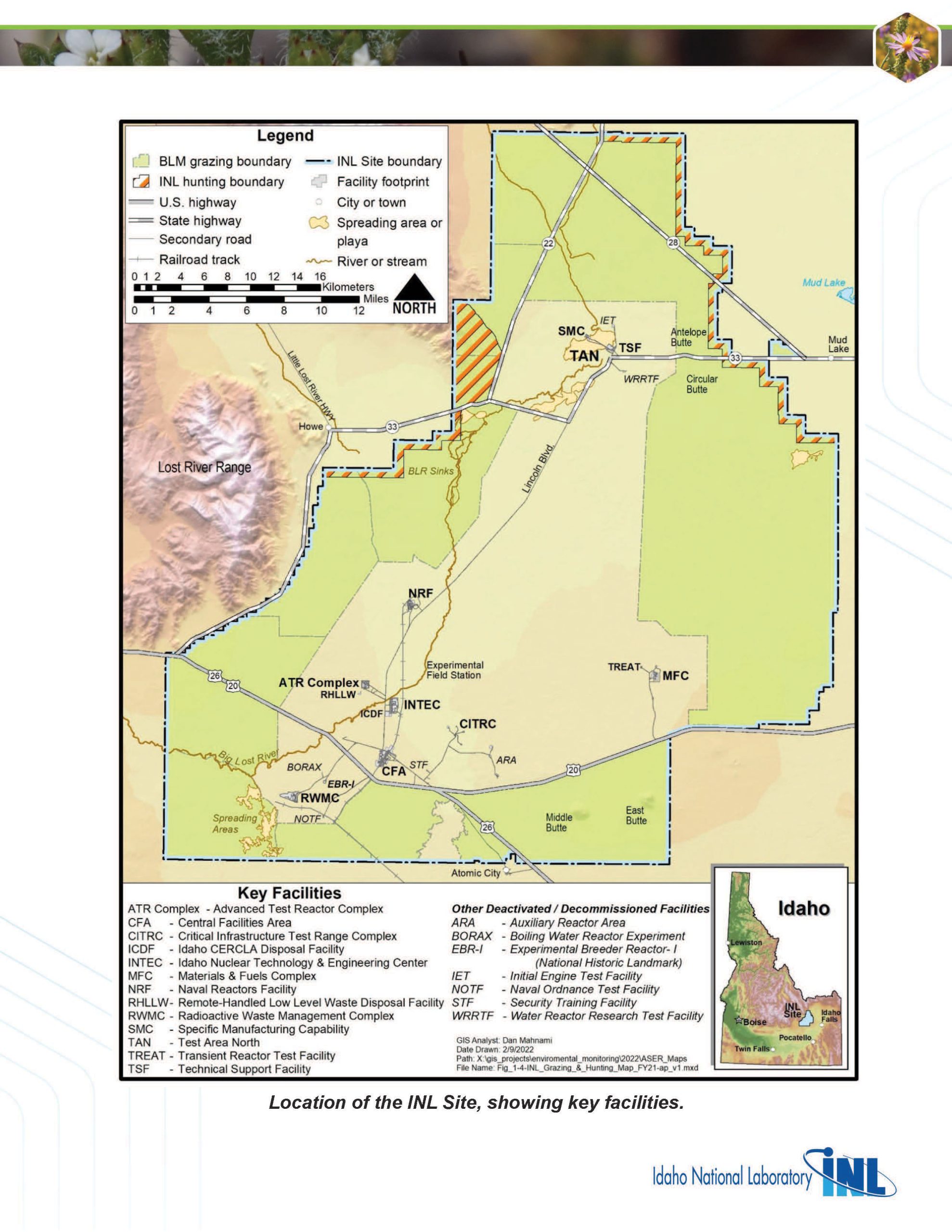
- Location of the INL Site
- Location of the INL Site, showing key facilities
- INL Site relation to the eastern Snake River Plain Aquifer
- INL Timeline
Quality Assurance
- Flow of environmental surveillance monitoring quality assurance elements
- Laboratory measurement elements
- Quality control program sampling elements
Waste Types
2023 Annual Site Environmental Report Chapters and Supplemental Reports
DOE/ID-12082 (23), ISSN 1089-5469, INL/RPT-24-76251, September 2024
2023 Report Chapters:
Executive Summary and Helpful Information
Chapter 2 – Environmental Compliance Summary
Chapter 3 – Environmental Management System
Chapter 4 – Environmental Monitoring Programs: Air
Chapter 5 – Environmental Monitoring Programs: Liquid Effluents
Chapter 6 – Environmental Monitoring Programs: Eastern Snake River Plain Aquifer
Chapter 8 – Dose to the Public and Biota
Chapter 9 – Natural and Cultural Resources Conservation and Monitoring
Chapter 10 – Quality Assurance of Environmental Surveillance Programs
Appendix A – Chapter 5 Addendum
Appendix B – Dosimeter Measurements and Locations
2023 Supplemental Reports:
2023 Technical Reports:
Appendix B: Verification Benchmark Problem
Total Effective Dose from INL Airborne Releases for the 2023 ASER Report
2023 Quarterly Environmental Reports:
2022 Annual Site Environmental Report Chapters and Supplemental Reports
DOE/ID-12082 (22), ISSN 1089-5469, INL/RPT-23-74740, October 2023
2022 Report Chapters:
Executive Summary and Helpful Information
Chapter 2 – Environmental Compliance Summary
Chapter 3 – Environmental Management System
Chapter 4 – Environmental Monitoring Programs: Air
Chapter 5 – Environmental Monitoring Programs: Liquid Effluents
Chapter 6 – Environmental Monitoring Programs: Eastern Snake River Plain Aquifer
Chapter 8 – Dose to the Public and Biota
Chapter 9 – Natural and Cultural Resources Conservation and Monitoring
Chapter 10 – Quality Assurance of Environmental Surveillance Programs
Appendix A – Chapter 5 Addendum
Appendix B – Dosimeter Measurements and Locations
2022 Supplemental Reports:
2022 Technical Reports:
Attachment to Appendix B: Verification Benchmark Problem
Total Effective Dose from INL Airborne Releases for the 2022 ASER Report
2022 Quarterly Environmental Reports:
2021 Annual Site Environmental Report Chapters and Supplemental Reports
DOE/ID-12082(21), ISSN 1089-5469, INL/RPT-22-68974, September 2022
2021 Report Chapters:
Executive Summary and Helpful Information
Chapter 2 – Environmental Compliance Summary
Chapter 3 – Environmental Management System
Chapter 4 – Environmental Monitoring Programs: Air
Chapter 5 – Environmental Monitoring Programs: Liquid Effluents
Chapter 6 – Environmental Monitoring Programs: Eastern Snake River Plain Aquifer
Chapter 8 – Dose to the Public and Biota
Chapter 9 – Natural and Cultural Resources Conservation and Planning
Chapter 10 – Quality Assurance of Environmental Surveillance Programs
Appendix A – Environmental Statutes and Regulations
Appendix B – Chapter 5 Addendum
Appendix C – Onsite Dosimeter Measurements and Locations
2021 Supplemental Reports:
Statistical Methods Used in the Idaho National Laboratory Annual Site Environmental Report
Summary of Historical Environmental Monitoring
2021 Technical Reports:
Attachment to Appendix B: Verification Benchmark Problem
Total Effective Dose from INL Airborne Releases for the 2021 ASER Report
2021 Quarterly Environmental Reports:
ASER (1999-2020)
2020 ASER
2019 ASER
2018 ASER
2017 ASER
2016 ASER
2015 ASER
2014 ASER
2013 ASER
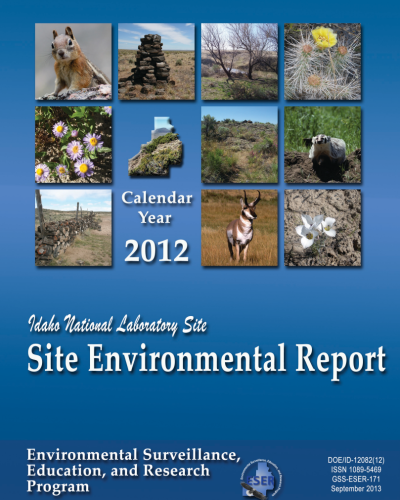
2012 ASER
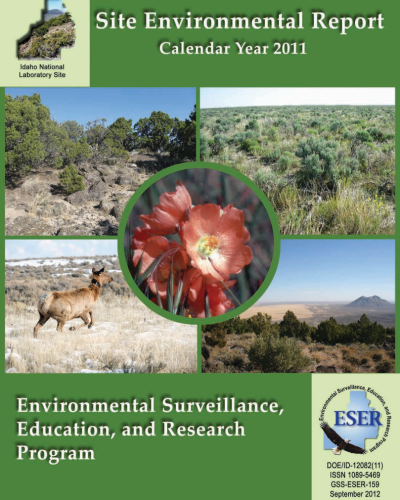
2011 ASER
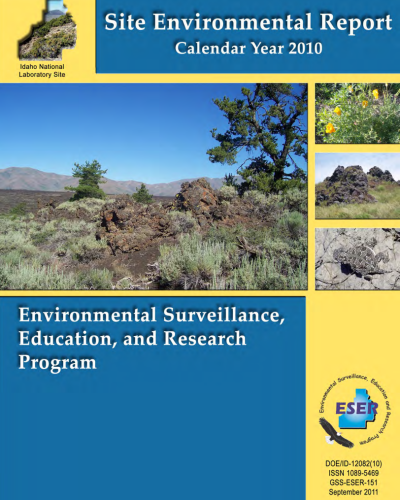
2010 ASER
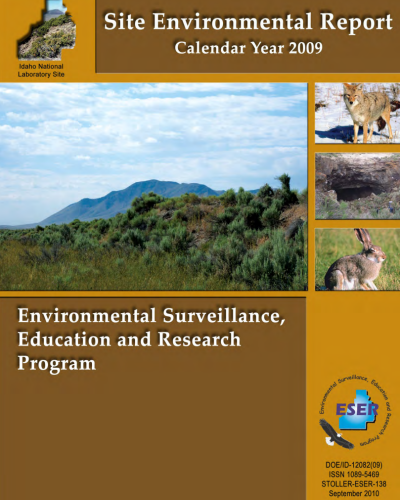
2009 ASER
2008 ASER
2007 ASER
2006 ASER
2005 ASER
2004 ASER
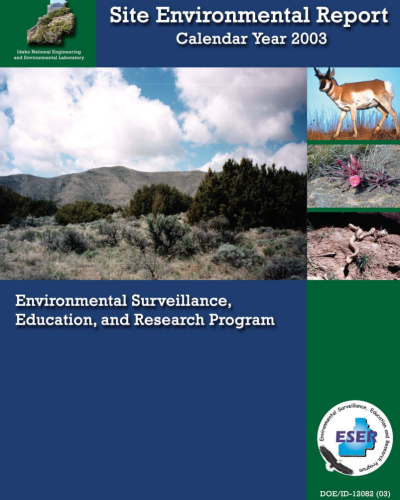
2003 ASER
2002 ASER
2001 ASER
2000 ASER
1999 ASER
Program Areas
Environmental Monitoring
The lab’s Environmental Monitoring program performs constant monitoring to check for these contaminants and ensure that the environment is safe for people, wildlife and vegetation. The team collects environmental samples at the desert Site and surrounding areas.
Natural Resources
The INL desert Site consists of 890-square miles of land and is a critical component to the Department of Energy-Idaho’s understanding of environmental resources in southeast Idaho. INL has a natural resources team that provides ecological support for vegetation and wildlife at INL.
Environmental Publications
INL publishes a variety of reports as part of its commitment to environmental stewardship and full compliance with environmental protection laws and regulations. These reports ensure that the lab’s mission can be achieved with little to no impact on the environment, wildlife and vegetation.