Consequence-driven Cyber-Informed Engineering (CCE) is a methodology focused on securing the nation’s critical infrastructure systems.
Developed at Idaho National Laboratory, CCE begins with the assumption that if a critical infrastructure system is targeted by a skilled and determined adversary, the targeted network can and will be penetrated.
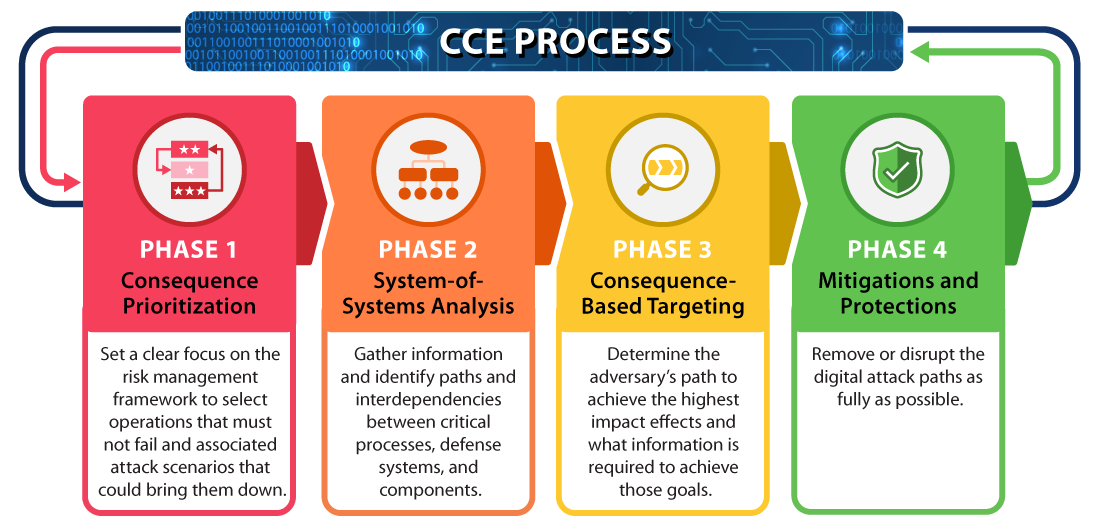
This “think like the adversary” approach provides critical infrastructure owners and operators a four-phase process for safeguarding their critical operations.
CCE Methodology and Four-Phase Process
CCE provides a four-phase process for safeguarding critical infrastructure operations. The following graphic and animation provide more information for each of the four phases of the CCE Methodology and the Kill Chain Workflow.
Provides critical infrastructure companies with a self-guided approach to conducting their own CCE effort and is focused on preventing the sabotage of critical infrastructure functions. Regional ACCELERATE training opportunities are sponsored by the Department of Energy, facilitated by Idaho National Laboratory.
Registration:FREE. Registrants are responsible for travel expenses (flight, hotel and meals). For registration related questions, contact nhs-training@inl.gov
Fundamentals of Industrial Control Systems (ICS) Training
An introduction to energy sector control systems and operations, includes tours of area infrastructure companies and facilities.
Registration:FREE. U.S. CITIZENS ONLY. Registrants are responsible for travel expenses (flight, hotel and meals). For registration related questions, contact nhs-training@inl.gov