
Grounded Reasoning for AI and National Security
GRAINS applies mathematically rigorous methods to improve confidence in AI-enabled systems used for national security and critical infrastructure.

Grounded Reasoning and Formal Methods
The Grounded Reasoning for AI and National Security (GRAINS) alliance brings together researchers, practitioners and policymakers to strengthen the security and reliability of systems vital to national security.
GRAINS focuses on formal methods — mathematical techniques for precisely describing how a system should behave and analyzing whether it can behave differently. Researchers can use these methods to examine possible system behaviors, test them against defined requirements and identify conditions that could lead to errors or unintended outcomes.
Formalized assurance extends that rigor from the model to the implemented system. This connection is particularly important for critical systems, where differences between intended and actual behavior can introduce errors or vulnerabilities with serious consequences.
GRAINS Mission
Advance the use of formal methods to strengthen the security, reliability and resilience of systems vital to national security.

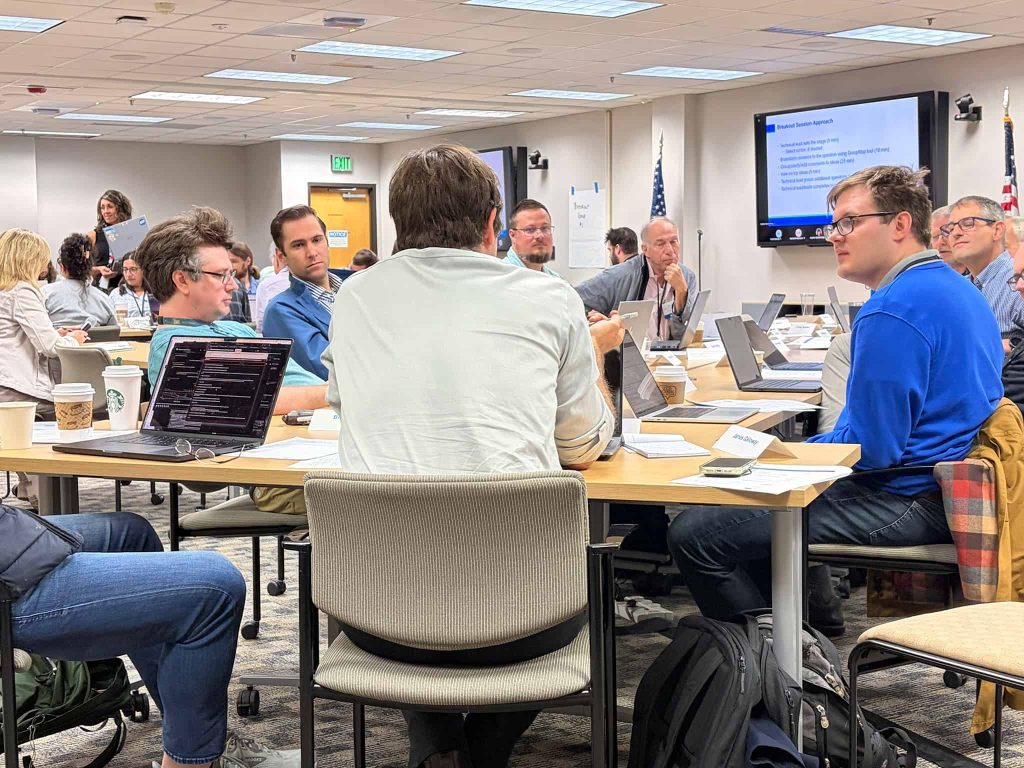
Grounded Reasoning for AI and National Security (GRAINS) Workshop
- September 15—17, 2026 (PAST EVENT)
- Idaho Falls, ID
The GRAINS Workshop focuses on practical applications of formal methods to AI-enabled systems, with discussions addressing critical infrastructure, national security and emerging technical challenges.
Why Formal Methods Matter
Formal methods provide a rigorous way to analyze complex systems and determine whether they behave according to their specifications. Different methods provide different approaches to specifying, analyzing and verifying system behavior.
Model Checking
This technique involves exploring all possible states of a system model to verify properties like safety and liveness.
Theorem Proving
This approach uses mathematical proofs to verify that system adheres to its specifications.
Formal Specification Languages
Formal languages such as linear temporal logic are used to write formal specifications of systems.
Abstract Interpretation
This technique involves analyzing the behavior of programs by constructing abstract models of their possible executions.
Formal Methods for National Security
Formal methods can help address security and reliability challenges across critical systems, from identifying cyber vulnerabilities to improving fault tolerance.
Elevating Cyber Defense and Vulnerability Detection
- Rigorous specification: Formal methods provide precise and unambiguous specifications of system behavior, reducing the risk of security vulnerabilities due to misunderstandings or ambiguities in requirements.
- Verification of security properties: By proving that certain security properties – confidentiality, integrity and availability – hold, formal methods help ensure that systems are resistant to various types of attacks.
- Detection of vulnerabilities: Formal verification can identify vulnerabilities that might be missed by conventional testing, such as those resulting from complex interactions or edge cases.
Fault Tolerance in Critical Infrastructure
- Fault tolerance: Formal methods can be used to prove that a system will continue to operate correctly even in the presence of certain faults or failures, enhancing its resilience.
- Recovery mechanisms: These methods can specify and verify the correctness of recovery mechanisms, ensuring that systems can recover gracefully from unexpected states or conditions.
- Dependability: By rigorously proving that systems meet their specifications, formal methods contribute to the overall dependability, ensuring that systems can be trusted to perform reliably under various conditions.
Enhancing Fault Tolerance in Safety-Critical Systems
- Safety-critical systems: In domains such as aerospace, automotive, and health care, where system failures can result in catastrophic consequences, formal methods are essential for ensuring safety.
- Hazard analysis: Formal methods help in performing detailed hazard analysis, identifying potential sources of danger and proving that safety measures are effective.
- Regulatory compliance: Many safety-critical industries have stringent regulatory requirements. Formal methods can provide the necessary evidence to demonstrate compliance with these standards.
Advancing Formal Methods Through Collaboration
Applying formal methods to national security challenges requires more than advances in research. Moving those methods into practical use requires sustained coordination among researchers, technology developers, asset owners and operators, and government.
GRAINS brings together expertise from academia, industry, national laboratories and government to advance formalized assurance and translate research into practical approaches for critical systems.
The alliance aims to:
- Strengthen the national talent pipeline in applied formal methods.
- Provide actionable research results to supply-chain vendors, asset owners and operators.
- Increase capabilities to improve critical infrastructure security and resilience.
Connect with our Team
Questions about our research, capabilities or collaboration opportunities?
Our team is ready to connect you with the right experts and resources at INL.
GRAINS Team
General Inquiries