
Modernizing Regulation for Advanced Nuclear Energy
Improving efficiency while maintaining the highest standards for safety, security and environmental protection.

Regulation Modernization
The U.S. Department of Energy’s Office of Nuclear Energy (DOE-NE) has updated its rules to ensure safety, security and environmental protection are managed while making processes more efficient. These changes don’t remove safety requirements or lower standards — instead, they focus on making it easier to follow the rules and meet expectations.
The updates include removing unnecessary steps, combining overlapping rules, and prioritizing actions that improve safety and help the department achieve its goals. By simplifying procedures, DOE-NE is keeping up with the needs of today’s modern energy systems and technologies, ensuring clear, effective guidelines that work better for everyone.
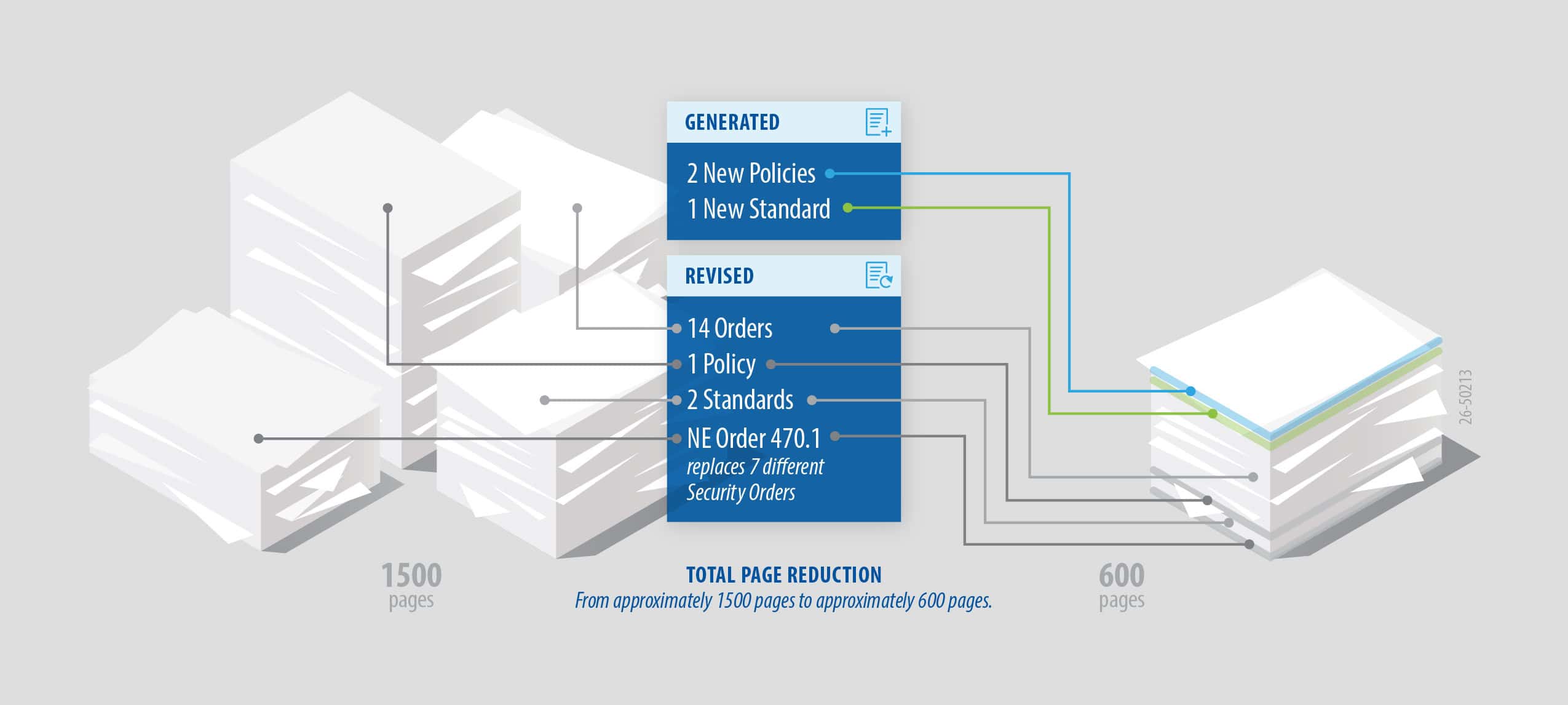
Regulation modernization in practice
DOE’s updated directives reduce unnecessary requirements while maintaining strong protections and focusing resources where they provide the greatest benefit.
| Before | After |
|---|---|
|
Sites exceeded standard worker safety requirements with additional measures beyond industry norms. |
Requirements align with effective industry safety practices while maintaining strong protections. |
|
Security directives prescribed specific equipment and procedures. |
Performance-based requirements allow experts to determine the best way to achieve security objectives. |
|
Information was reported multiple times in different formats. |
Duplicate reporting requirements have been eliminated. |
|
Low-risk structures required the same level of analysis as higher-risk facilities. |
Reviews are matched to risk, reserving detailed analyses for higher-risk facilities. |
Reduce Redundancies
Remove duplicate requirements and unnecessary processes.
Focus on Results
Emphasize outcomes that improve safety and mission performance.
Eliminate Red Tape
Reduce administrative burden so experts can focus on higher-value work.
Categorical Exclusions
The U.S. Department of Energy (DOE) has developed a more efficient process for reviewing low-risk projects, called a “categorical exclusion” under the National Environmental Policy Act (NEPA). This process helps prioritize environmental reviews where they matter most, ensuring that high-risk activities get thorough attention, while low-impact projects that consistently show minimal environmental effects can move forward more smoothly.
A categorical exclusion is a type of environmental review designed for actions that have been proven, through decades of analysis, to have minimal impact on the environment. It streamlines the process for activities shown to be safe for nature.
What does this mean for advanced reactor projects?
DOE uses this approach for certain advanced reactor activities that have been repeatedly evaluated and found to have minimal environmental risks. This allows environmental experts to focus their time and resources on higher-risk projects, avoiding unnecessary analysis of low-risk actions.
Key points about categorical exclusions
- Environmental protections stay in place
- Decades of research back this approach
- Risk-based decision-making

Advancing next-generation energy responsibly
How NEPA categorical exclusions streamline environmental review while maintaining strong environmental protections
1
Avoiding repeated analysis
2
Oversight continues beyond approval
3
Aligning review with risk
4
Supporting responsible innovation
5
Compliance with DOE Nuclear Energy
Connect with Subject Matter Experts
Our team can answer questions about regulation modernization, categorical exclusions and DOE efforts supporting advanced nuclear energy deployment.
Contact Us