
Advanced Grid Solutions
Driving practical solutions for real-world grid challenges.

Advanced Conductor Evaluations
INL, in collaboration with the National Electric Energy Testing Research and Application Center (NEETRAC) and the Electric Power Research Institute (EPRI), is conducting various tests on 5 different types of conductors. INL has also published previous test results over the last decade that have never been seen by the public. These tests show how conductors perform in real-world extremes that threaten grid stability. Sponsored by DOE’s Office of Electricity (OE) and Office of Cybersecurity, Energy Security, and Emergency Response (CESER).
Optimizing Energy Transmission and Distribution
The U.S. electrical grid faces major challenges: aging infrastructure, rising power demand, and the need for optimized integration. These pressures strain transmission systems, and upgrades are costly and slow, creating a backlog nationwide. INL’s Advanced Grid Solutions Program works to identify, test, and integrate processes and innovative technologies that increase grid efficiency, reliability, affordability, and capability of meeting future energy demands.
To meet emerging demands, the Department of Energy supports research to close technology gaps, develop advanced modeling, and conduct large-scale field exercises on INL’s Power Grid Test Bed. INL’s two decades of expertise in Dynamic Line Rating strengthens these efforts.
This work enables regulators and utilities to assess benefits and risks, improve use of existing lines, support upgrades, maximize power transfer, and reduce congestion-related losses.
Advanced Conductor Scan Report (Addendum)
State-level maps show transmission lines across all 50 states and Puerto Rico that are candidates for reconductoring.
Grid Technologies
Grid technologies are tools and solutions that make our electric system more efficient, reliable, and adaptable. Below are examples of technology focus areas where INL applies expertise to help the grid operate more effectively today and prepare for tomorrow’s energy needs.
For a larger list of new and innovative grid technologies, visit gridtechpedia.inl.gov.
Natural Hazards
Natural hazards and extreme weather increasingly threaten communities and critical infrastructure. INL, with funding from the US Department of Energy, works to reduce risks to the energy sector from events like wildfires, hurricanes, and even space weather such as solar flares. Learn more about what INL is doing to help mitigate these threats to the grid.
Reports Archive
Explore technical reports, studies, and analyses that document grid-enhancing technologies, modeling insights, and findings from real-world field evaluations. These resources support stakeholders in understanding emerging tools, methods, and opportunities for advancing grid performance.
| Image | PDF Link | Title | Subhead | Year | Category |
|---|---|---|---|---|---|
 | https://inl.gov/content/uploads/2023/03/Real-Time-and-Forecasted-DLR-Use-Cases.pdf | Real-Time and Forecasted DLR | Use Cases | 2023 | Transmission Capacity, Grid Reliability, Grid Affordability, Grid Resilience |
 | https://inl.gov/content/uploads/2024/03/Voltage-Optimization.pdf | Voltage Optimization | 2024 | Power System Stability, Grid Resilience | |
 | https://inl.gov/content/uploads/2024/03/Shunt-Connected-FACTS-and-Synchronous-Condensers.pdf | Shunt-Connected FACTS and Synchronous Condensers | 2024 | Power System Stability | |
 | https://inl.gov/content/uploads/2024/03/POWER_Grid-Enhancing-Technologies.pdf | Grid Enhancing Technologies | 2024 | Power System Stability, Transmission Capacity, Grid Reliability, Grid Affordability, Grid Resilience | |
 | https://inl.gov/content/uploads/2024/03/POWER_Variable-Ratings.pdf | Variable Transmission Line Ratings | 2024 | Power System Stability, Grid Reliability, Grid Affordability | |
 | https://inl.gov/content/uploads/2024/03/Cybersecurity-Considerations-for-Dynamic-Line-Rating-Deployment.pdf | Cybersecurity Considerations for Dynamic Line Rating Deployment | 2024 | Power System Stability, Grid Resilience, Grid Affordability | |
 | https://inl.gov/content/uploads/2024/03/Implementation-of-PFC-solutions.pdf | Implementation and Operation of Power Flow Control Solutions | for Transmission Systems | 2024 | Power System Stability, Grid Affordability, Grid Resilience |
 | https://inl.gov/content/uploads/2024/04/23-50856_R13_-AdvConductorsScanProjectReportCompressed.pdf | Advanced Conductor | Scan Report | 2023 | Advanced Conductors, Transmission Capacity, Grid Affordability, Grid Reliability, Grid Resilience |
 | https://inl.gov/content/uploads/2024/04/24-50516_R3_Industry-Scan-of-non-SF6-Gas-Insulated-Technologies-Report.pdf | Industry Scan | of Non-SF6 Gas Insulated Technologies | 2024 | Grid Affordability, Grid Reliability |
 | https://inl.gov/content/uploads/2024/02/23-50856_R4a_-Use-Case-Studies.pdf | Advanced Conductor | Use Case Studies | 2023 | Advanced Conductors |
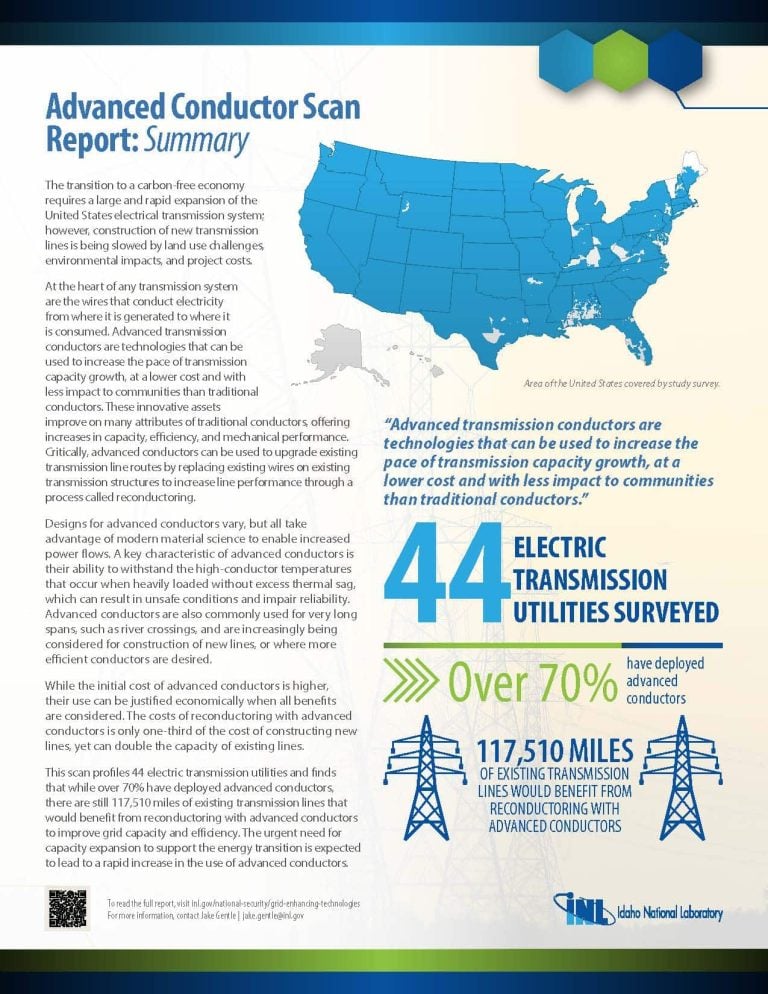 | https://inl.gov/content/uploads/2024/04/23-50856_R3_-Summary.pdf | Advanced Conductor Scan Report | Summary | 2023 | Advanced Conductors |
 | https://inl.gov/content/uploads/2023/07/INL_Reconductoring-State-Maps-Addendum_Final_20250923.pdf | Advanced Conductor Scan Report Addendum | State-Level Maps of Reconductoring Potential | 2025 | Advanced Conductors, Grid Affordability, Grid Resilience, Transmission Capacity, Grid Reliability |
 | https://inl.gov/content/uploads/2023/11/Congressional_DLR_Report_June2019_final_508_0.pdf | Dynamic Line Rating | Report to Congress | 2019 | Grid Affordability, Grid Reliability, Grid Resilience |
 | https://www.energy.gov/sites/default/files/2022-04/Grid%20Enhancing%20Technologies%20-%20A%20Case%20Study%20on%20Ratepayer%20Impact%20-%20February%202022%20CLEAN%20as%20of%20032322.pdf | Grid Enhancing Technologies: | A Case Study on Ratepayer Impact | 2022 | Grid Affordability, Transmission Capacity, Power System Stability, Grid Reliability, Grid Resilience |
 | https://inl.gov/content/uploads/2023/09/23-50118_DLR_Calculation_Engine_R1.pdf | DLR Calculation Engine | Interoperability Profile | 2023 | Transmission Capacity, Control Room Integration, Power System Stability |
 | https://inl.gov/content/uploads/2023/03/A-Guide-to-Case-Studies-for-Grid-Enhancing-Technologies.pdf | A Guide to Case Studies | of Grid Enhancing Technologies | 2022 | Grid Affordability, Transmission Capacity, Power System Stability, Grid Reliability, Grid Resilience |
 | https://inl.gov/content/uploads/2024/04/A_Use_Case_Structure_for_Technology_Integration-1.pdf | A Use Case Structure | for Technology Integration | 2022 | Control Room Integration |
 | https://inl.gov/content/uploads/2024/04/Integration_of_New_Technology_Considering_the_Trade-Offs_Between_Operational_Benefits_and_Risks_A_Case_Study_of_Dynamic_Line_Rati.pdf | Integration of New Technology | Considering the Trade-Offs Between Operational Benefits and Risks: A Case Study of Dynamic Line Rating | 2025 | Control Room Integration |
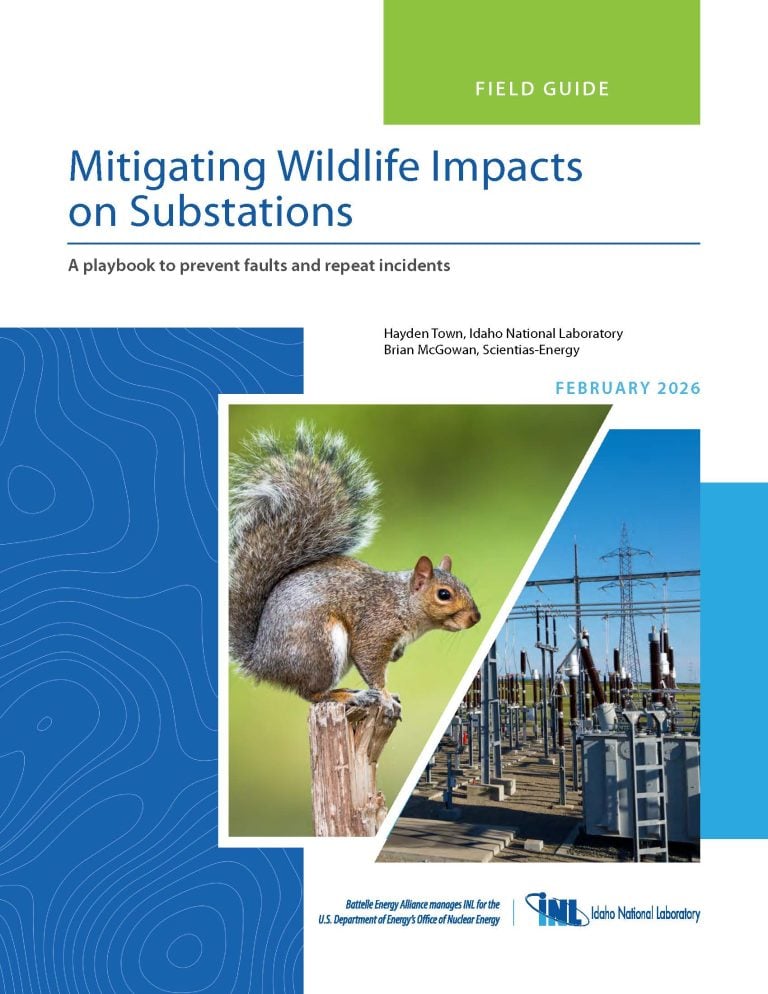 | https://inl.gov/content/uploads/2026/04/Wildlife-Substation-Field-Guide_INL.pdf | Mitigating Wildlife Impacts on Substations – Field Guide | 2026 | Grid Reliability, Grid Resilience | |
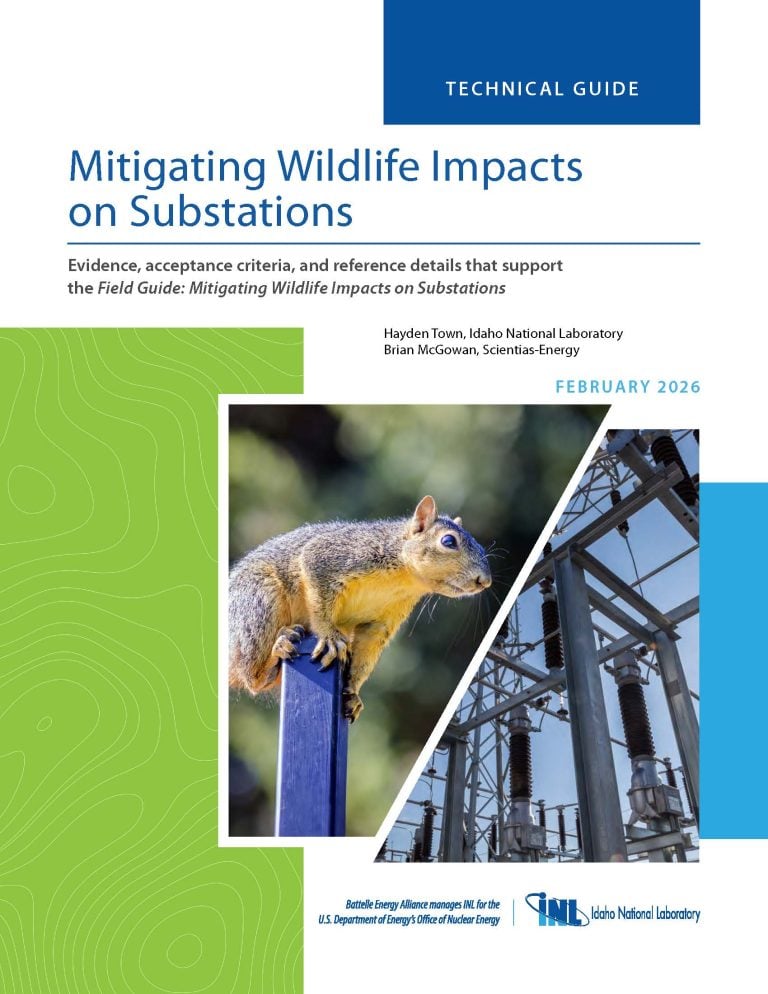 | https://inl.gov/content/uploads/2026/04/Wildlife-Substation-Technical-Guide_INL.pdf | Mitigating Wildlife Impacts on Substations – Technical Guide | 2026 | Grid Reliability, Grid Resilience | |
 | https://www.osti.gov/servlets/purl/3020629 | Mechanical Solution for Existing Conductors | 2026 | Advanced Conductors, Grid Reliability |
GETs Implementation FAQs
Implementing grid-enhancing technologies can be complex. The items below provide guidance on key steps, cost considerations, data needs, and deployment insights to support effective GETs adoption by utilities and industry partners.
Steps for GETs Location Identification
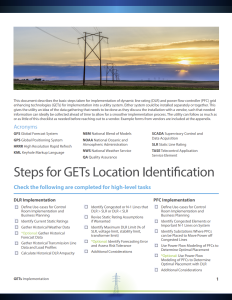
This guide outlines the basic steps for implementing two types of grid enhancing technologies: Dynamic Line Rating and Power Flow Controllers. These technologies can be installed individually or together, depending on the utility’s needs.
The purpose of this document is to help utilities understand what data they need to collect before engaging with a vendor. Gathering this information early can make the installation process smoother and more efficient.
Utilities can use as much or as little of the checklist as they find helpful before contacting a vendor. Sample vendor forms are included in the appendix for reference. Click here for blank. Click here for example.
GETs Costs
Since the GETs industry is relatively new, potential device users do not always know how much an investment in GETs will cost. Similarly, there is no valuation framework to estimate the benefit provided by GETs. One challenge with valuation is that many benefits may come from avoiding additional costs, such as using higher priced generators or even avoiding an outage caused by congestion. INL has identified multiple factors to consider in a cost/benefit analysis:
- Cost of devices
- Cost of design work (impact analysis, device placement, sizing needs, siting analysis)
- Cost of installation (extra materials, labor, etc.)
- Cost of maintenance (monitoring device health)
- Cost of licensing (continuing to receive support and/or connection to devices from vendors)
- Avoided costs of energy (e.g., using more wind energy instead of a peaker plant generator)
- Avoided costs of outages (e.g., can safely push more power over a line or can redirect power to reduce congestion)
- Ability to serve more load
- Ability to perform maintenance in opportune windows
Modeling and Simulation
No potential GETs user will consider deploying these technologies without first understanding how they will impact their system. INL is working with project partners to build generic models of GETs technologies that can be used for power system modeling and simulation. Many GETs devices could change some of the fundamental building blocks of power system modeling. For example, line impedances are assumed to be static, but with PFC, they could be a controllable value. Line limits are also assumed to be static, but Dynamic Line Rating uses factors outside of traditional power system modeling to make this a dynamic value. While this adds complexity to an already dynamic and complicated problem, the solution unlocks potential for the grid of the future. Power flow modeling of the system can determine congestion and curtailment under both standard N-0 configurations for economic dispatch, as well as the congestion and curtailment under the N-1 contingencies (when one line is temporarily out of commission), which create tighter restrictions on the system. Under regular operations, there is typically high headroom on the line between its load and thermal capabilities, with large constraints only apparent in periods of high system electrical use or during N-1 contingency security. By building PFC and DLR into power system modeling, the impact of these GETs on peak times or contingency situations can be isolated, rather than generic statements claiming increases in capacity.
All Hazards Analysis (AHA) is a dynamic framework for dependency analysis, empowering the discovery of critical infrastructure insights and facilitating decision-making. Developed by Idaho National Laboratory, AHA identifies dependencies and associated risks, offering decision-makers and emergency managers a holistic perspective on interconnected infrastructure systems.
Deployment Challenges
Through a demonstration at the INL Site, the research team has documented challenges deploying GETs. By documenting the process and finding solutions, the team hopes to provide resources that promote the adoption of GETs and may avoid discouraging potential GETs users from adopting the technology.
- INL worked with vendors to use its on-site cellular network, promoting security of wireless communications.
- INL helped vendors navigate the registration process to be a subcontractor for government funds, which may help if future projects are partially funded by government awards.
- INL worked with vendors to customize solutions to the field constraints at the Site. Adapting deployment or installation practices to the customer’s needs will be important for GETs, which can be deployed for a wide range of potential applications.
Resources from the demonstration project, such as the request for proposal, test plans and lessons learned, will be published for industry reference.
Energy Curtailment Avoided vs. Costs
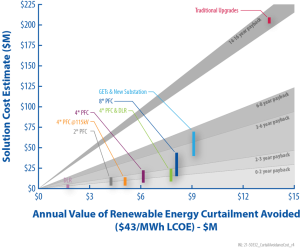 A recently published report, Grid Enhancing Technologies: A Case Study on Ratepayer Impact, focused on a set of lines in western New York that was analyzed to improve integration of new wind and solar power through DLR and PFC technologies. The GETs cases provide options to address curtailment at a fraction of the cost. The payback period appears to be faster for GETs than traditional upgrades, even though the life cycle is shorter. The study determined a range of costs for estimated GETs versus the curtailment avoided.
Industry Engagement
INL is working with several industry partners to research and advance the knowledge of Grid Enhancing Technologies and integrate solutions.
Project Partners
- EnerNex
- Power Engineers
- Telos Energy
Project Technology Providers
- WindSim Power
- Ampacimon
- Smart Wires
Drone Deployable DLR Sensors
Grid-enhancing technologies offer solutions to congestion problems, but cost is a concern. Engineers from Pitch Aeronautics have developed a drone system technology to reduce installation time, effort and cost. INL’s GETs experts collaborated with Pitch Aeronautics to develop a drone deployable Dynamic Line Rating sensor. The INL Technical Assistance Program provided 40 hours of free technical assistance, leading to a follow-on project demonstrating drone installation on a 13.8kV distribution line.
Advancing the Grid at INL
INL supports the electric power sector through applied research, testing, cybersecurity, and collaboration. These highlights reflect ongoing work to strengthen grid reliability, security, and performance.
Connect with our Team
Questions about our research, capabilities or collaboration opportunities?
Our team is ready to connect you with the right experts and resources at INL.
Jake Gentle