Critical materials supply chains are complex, globally interconnected networks that enable access to materials that are essential for energy systems, advanced manufacturing and national defense. These supply chains, however, are increasingly vulnerable to threats that transcend borders and industries. Strategic plans, or roadmaps, developed to address these challenges can become outdated as soon as conditions change. Keeping a roadmap relevant requires frequent updates and technologies that can keep pace with a rapidly changing landscape.
“Critical materials supply chains are vulnerable to geopolitical, economic, and environmental shocks,” said Lionel Toba, a modeling and simulation professional at Idaho National Laboratory. “It’s not feasible or effective to monitor every variable in isolation through conventional analyst intelligence methods, especially as complexity grows.”
To overcome these challenges and strengthen critical material supply chains, scientists at the Idaho National Laboratory, with funding from the Advanced Materials and Manufacturing Technologies Office’s Critical Materials Innovation Hub and High Performance Materials program, created FORESIGHT, a suite of AI-powered tools that uses complex analyses of current supply chain variables to show users what’s working, what’s not and where to focus resources.
Why INL
INL has more than 20 years of experience in supply chain research and a diverse portfolio of adaptive, data-driven roadmaps and tools that account for changes in supply chains and enable timely, informed decision-making.
“Within the Department of Energy ecosystem, we’re uniquely positioned to tackle supply chain challenges through AI,” said Michael Severson, another modeling and simulation professional at INL. “We bring together AI expertise, machine learning and supply chain domain knowledge under one roof.”
FORESIGHT strengthens supply chain resilience
FORESIGHT identifies the patterns, dependencies and underlying causes of supply chain disruptions to help teams build more adaptable and resilient critical materials supply chains.
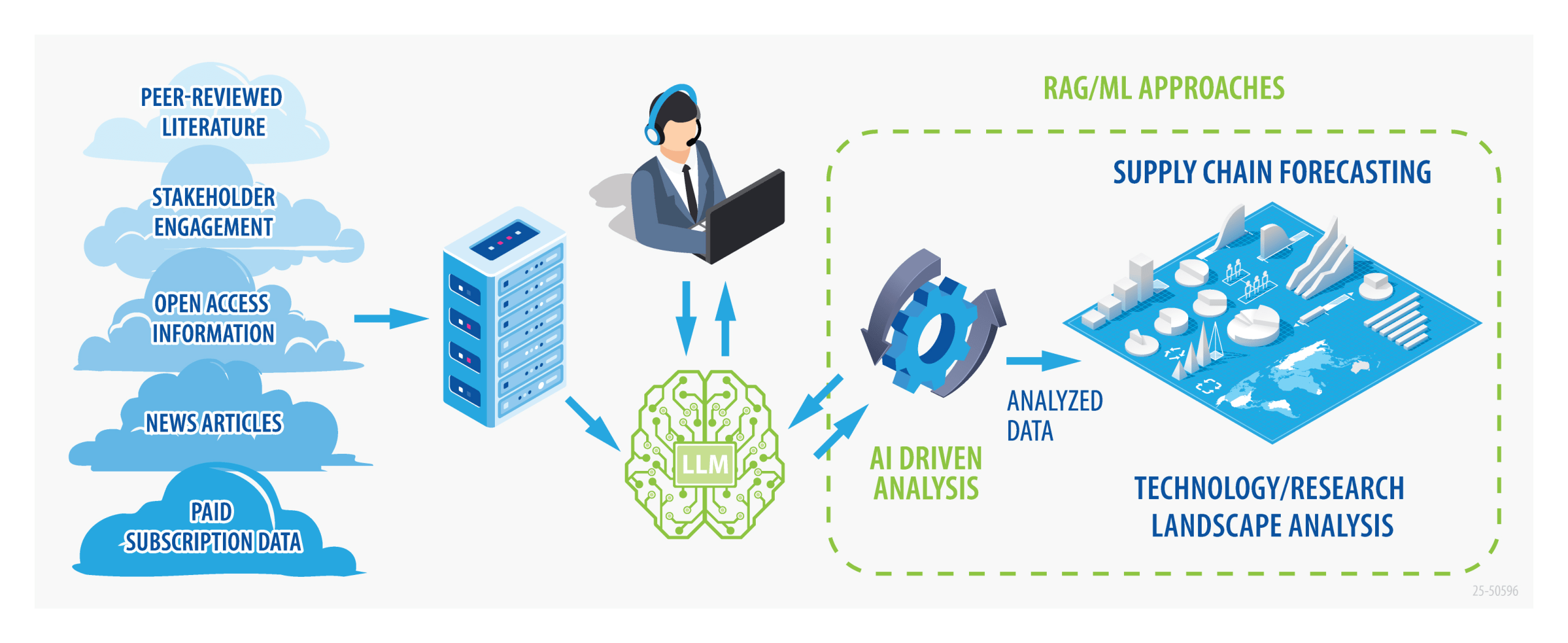
As part of FORESIGHT, information from sources like United States Geological Survey reports, academic articles, news articles and other web content was organized into a structured network. In this network, key entities such as companies or countries are represented as nodes, along with relevant details like production capacity, imports and exports. The connections between these nodes capture how these entities are related. This organized structure serves as a knowledge base that they can use to analyze information and generate insights. One example is price prediction, where machine learning models estimate the price of gallium by considering factors such as supply, demand, geopolitical risks and historical price trends as contextual reference.
The FORESIGHT suite has nine core components:
- Forecasting: predicts supply chain disruptions before they occur
- Outlook: surfaces research trends to inform strategic planning
- Risk: quantifies severity and likelihood of supply chain threats
- Escalation: alerts stakeholders to emerging disruptions in real time
- Simulation: tests “what-if” scenarios and contingency plans
- Intelligence: scans news, social media, reports and more to spot potential problems
- Geospatial: maps supply chain networks to identify vulnerabilities and bottlenecks
- Hazard: identifies and mitigates safety-related operational tasks
- Trends: tracks emerging technologies and patterns in supply chain management
An innovative solution
FORESIGHT has already demonstrated its value across multiple DOE program portfolios, including the Critical Materials, and High‑Performance Materials programs, where it uncovered critical research knowledge gaps and reduced the landscape review workload for DOE managers by roughly 90%. FORESIGHT enhances the supply chain research led by the CMI hub, transforming real-world complexity and uncertainty into dynamic, data-driven scenarios, and enabling models to simulate not just expected futures, but emerging ones.
Identifying and closing these knowledge gaps reduces risk and accelerates the path to production. To keep stakeholders aligned with real‑time developments, FORESIGHT generates a monthly update summarizing research progress, new challenges, key milestones, and where future investments will have the greatest impact on supply chain resilience.
“Our objective was to fundamentally improve supply chain analysis,” said Toba. “In the past, simulation models have allowed us to explore ‘what-if’ scenarios, but they are often static representations of the system—snapshots built on predefined assumptions and the modeler’s interpretation of how the supply chain operates. These approaches can oversimplify dynamic relationships and emerging risks.”
Future development will expand FORESIGHT’s AI‑enabled capabilities, including machine learning and materials‑focused analytics, to better monitor and predict supply chain challenges or disruptions across DOE programs. This evolution will further strengthen FORESIGHT’s role in supporting AMMTO and CMI priorities.
To keep FORESIGHT adaptable in a continuously changing environment, the team is using large language models (LLMs), a type of machine learning that can make sense of complex, dynamic information, along with other AI tools and frameworks that enable the continuous ingestion of structured and unstructured data, support reasoning and identify hidden dependencies.
“As we build out these tools, we have several goals,” said Toba. “One is to create a domain-specific LLM that’s like a critical materials encyclopedia and knows everything there is to know about supply chains. Another is expanding predictive capabilities, with forecasts of material prices, supply-demand balance and potential supply chain disruptions.”
INL’s FORESIGHT can help stakeholders better prevent or prepare for disruptions instead of reacting to them.
“FORESIGHT can offer decision-makers accurate assessments to stay informed,” said Severson. “It builds on previous supply chain work we’ve conducted and streamlines and allows for faster resolutions. Those who are better informed will make better decisions and be better stewards of taxpayer money.
The Critical Materials Innovation Hub is an Energy Innovation Hub led by the U.S. Department of Energy’s Ames National Laboratory with support from the Critical Minerals and Energy Innovation Office’s Advanced Materials and Manufacturing Technologies Office. CMI seeks ways to accelerate the development of critical material technologies and enhance the innovation pipeline for U.S. supply chains by accelerating research, educating a robust workforce and creating de-risked, commercial-ready technologies in partnership with American industry.