
Water Power Resources
INL water power publications, reports, fact sheets, videos and presentations provide technical information and results from hydropower research.

Water Power 101
Hydropower systems take many forms, from conventional dams and run-of-river facilities to pumped storage and irrigation systems. These fundamentals explain how water generates electricity, how hydropower supports the electric grid and how different technologies can work together.
What is hydropower?
Hydropower, also known as hydroelectric power, uses the energy of moving water to generate electricity.
As water flows through a hydropower plant, it pushes the blades of a turbine, causing the turbine to spin. A generator converts that mechanical energy into electricity. The amount of electricity a hydropower system can generate depends on factors including the amount of water flowing through the system and the change in elevation the water experiences.
What are the benefits of hydropower?
Hydropower provides reliable, flexible electricity from a domestic energy source. Hydropower facilities can adjust generation in response to changing electricity demand, helping support grid stability and providing power during disruptions.
Hydropower facilities can also provide long-term value from infrastructure designed to operate for decades. Depending on the facility, hydropower infrastructure may support other needs such as water supply, irrigation and flood control.
What are the main types of hydropower?
Hydropower systems vary in how they manage and use moving water to generate electricity. Common types include conventional hydropower, pumped-storage hydropower and run-of-river hydropower.
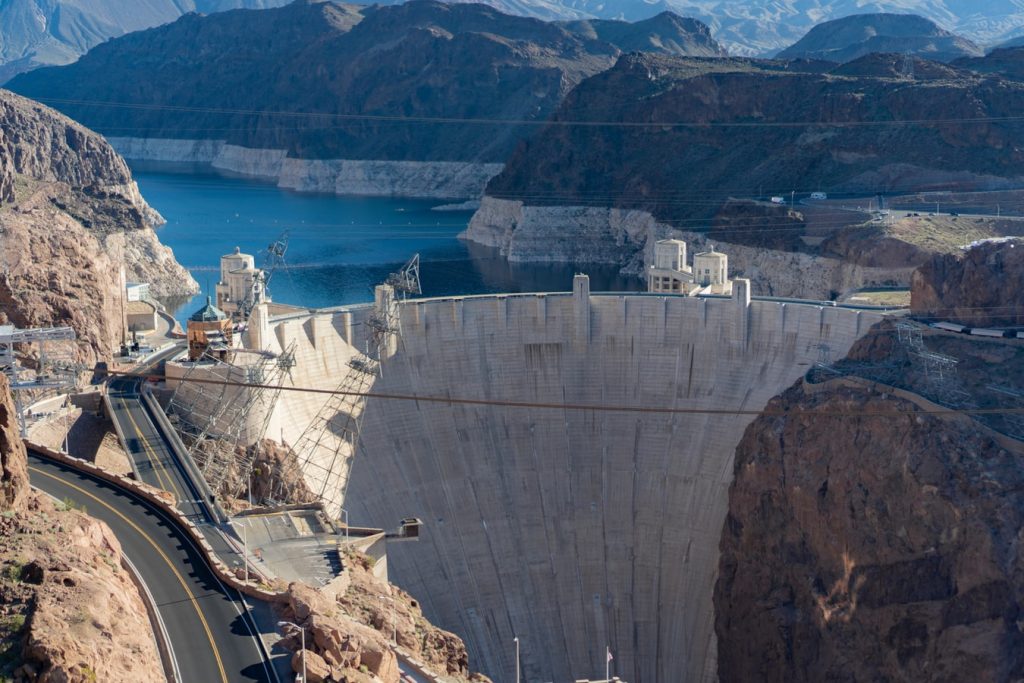
Conventional Hydropower Dams
Conventional hydropower uses water stored in a reservoir behind a dam. When water is released, it flows through turbines that drive generators to produce electricity.
The most famous hydropower dam in the United States is the Hoover Dam, which powers a large swath of the Southwest United States. The enormous height difference between the upper reservoir (Lake Mead) and the outlet of water at the bottom of the dam contributes to the massive yearly 4.2 billion kilowatt-hours of energy it generates; enough to power over 385,000 homes for one year.
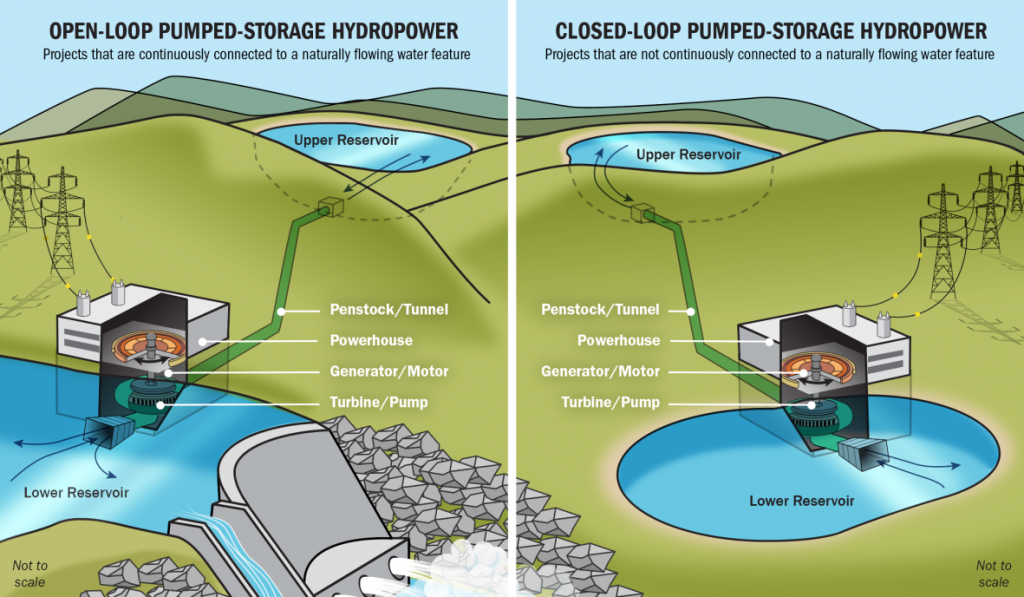
Pumped-Storage Hydropower
Pumped-storage hydropower uses two reservoirs at different elevations. When electricity is needed, water is released from the upper reservoir through turbines to generate power. When electricity demand is lower, water can be pumped back to the upper reservoir for later use.
Pumped storage can also work with variable power sources such as wind and solar. When electricity generation exceeds demand, excess electricity can be used to pump water to the upper reservoir, where the energy is stored. When more electricity is needed, the stored water is released to generate hydropower. This helps balance electricity supply and demand and gives power systems greater flexibility.
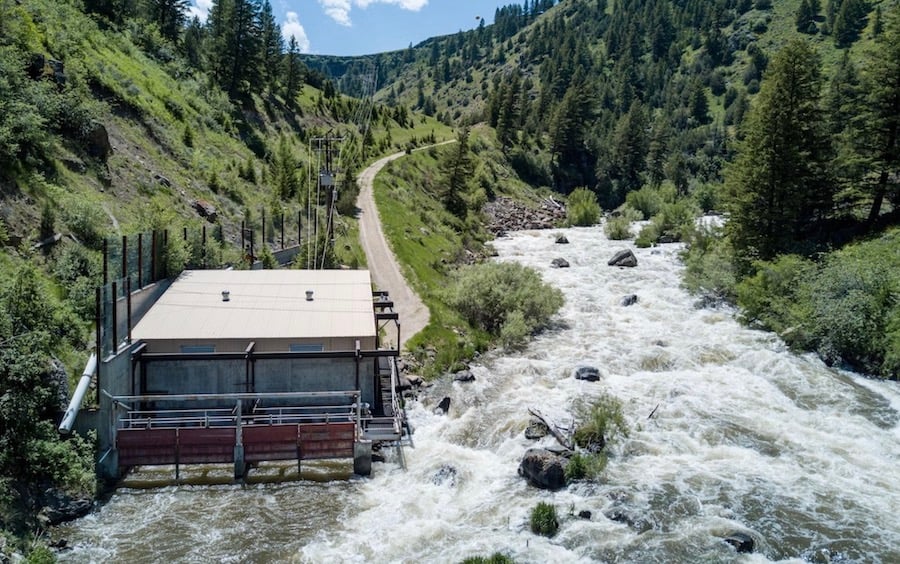
Run-of-River Hydropower
Run-of-river hydropower generates electricity from flowing water with little or no reservoir storage. These systems may use a natural change in elevation or divert a portion of a river or canal through turbines before returning the water to its source.
Run-of-river systems range in size and can be used on rivers, streams and canals.
How can hydropower work with energy storage?
Hydropower can be integrated with energy storage technologies such as batteries, flywheels and ultracapacitors. Power system controls coordinate the hydropower plant and storage devices so they can operate as an integrated system.
Energy storage can act as a “virtual reservoir,” allowing the combined system to respond more quickly to changing grid needs. This can support grid stability and reliability, reduce wear on hydropower components, improve ramp times and increase overall system efficiency.
Different storage technologies also provide different capabilities. Combining technologies such as batteries, ultracapacitors and flywheels can take advantage of their individual performance characteristics to support the needs of the hydropower system.
How are irrigation systems connected to water power?
Irrigation canals and pipelines move water across agricultural areas, often using gravity to deliver water without pumps or other complex machinery. Because moving water contains energy, irrigation infrastructure can also provide opportunities for hydropower generation.
Hydropower can be added to suitable canals, pipelines and other parts of an irrigation system to generate electricity as water moves through the infrastructure. Modernization projects may combine these energy opportunities with improvements that reduce water losses, improve water delivery and lower operating costs.
Fact Sheets
The installation of a self-healing microgrid is enhancing grid resilience in the remote village of Cordova, Alaska.
Idaho National Laboratory’s advanced modeling capabilities can incorporate real-world data, hardware and software into real-time simulations.
The installation of a self-healing microgrid is enhancing grid resilience in the remote village of Cordova, Alaska.
Adding hydropower generation to a fraction of existing non-powered dams represents a significant opportunity to reduce the nation’s greenhouse gas emissions with minimal environmental impact. To realize this opportunity, researchers at INL and Pacific Northwest National Laboratory (PNNL) developed an interactive, web-based tool.
Researchers at Idaho National Laboratory and PNNL are helping the private sector accelerate the modernization of irrigation systems through the publicly available tool IrrigationViz.
Publications and Reports
| Type | Authors | Title | Publication |
|---|---|---|---|
| Journal | Banerjee, Abhishek, Alam, S M Shafiul, Mosier, Thomas M | Impact of Hybrid Energy Storage System Topology on Performance: Exploration for Hydropower Hybrids | Proceedings of the 54th Hawaii International Conference on System Sciences | 2021 |
| White Paper | Shafiul Alam, S. M., Banerjee, Abhishek, Loughmiller, Cliff, Bennett, Brion D., Smith, Nicholas, Mosier, Thomas M., Gevorgian, Vahan, Jenkins, Ben, and Roberts, Matthew. | Idaho Falls Power Black Start Field Demonstration (Preliminary Outcomes Paper). United States: N. p., 2021. Web. doi:10.2172/1817907. | INL Preliminary Outcomes Paper |
| Journal | Yingqian Lin, Binghui Li, Thomas M.Moiser, L. Michael Griffel, Matthew R.Mahalik. Jonghwan Kwon, S. M. Shafiul Alama | Revenue prediction for integrated renewable energy and energy storage system using machine learning techniques | "Journal of Energy Storage Volume 50, June 2022, 104123" |
| Journal | Vivek Kumar Singh, Abhishek Banerjee, S M Shafiul Alam, Thomas M Mosier | Dynamic Frequency Regulation Improvement in Hydropower-Hybrid System using Variational Mode Decomposition | 2022 IEEE/PES Transmission and Distribution Conference and Exposition (T&D), 25-28 April 2022 |
| Journal | Abhishek Banerjee, S M Shafiul Alam, Thomas M. Mosier, John Undrill | Modeling a Bulb-Style Kaplan Unit Hydrogovernor and Turbine in Mathworks-Simulink and RTDS-RSCAD | 2022 IEEE/PES Transmission and Distribution Conference and Exposition (T&D), 25-28 April 2022 |
| Journal | Mohammad S. Roni, Thomas Mosier, Tzvi D. Feinberg, Timothy McJunkin. Ange-Lionel Toba, Liam D.Boire, Luis Rodriguez-Garciac, Majid Majidi, Masood Parvaniac | Integrated water-power system resiliency quantification, challenge and opportunity | Energy Strategy Reviews, Volume 39, January 2022, 100796 |
| Journal | Ange-Lionel Toba, Liam Boire, Timothy McJunkin | Integrated Water-Power System Resilience Analysis in a Southeastern Idaho Irrigation District: Minidoka Case Study | Sustainability 2021, 13(19), 10906 |
| Journal | Luis Rodriguez-Garcia, Masood Parvania, Mohammad Mehdi Hosseini, Thomas Mosier | Resilience Analytics for Interdependent Power and Water Distribution Systems | IEEE Transactions on Power Systems, 08 February 2022 |
| Provisional Patent Application | T. Wang, V. K. Singh, A. Banerjee, S. M. Shafiul Alam and T. M. Mosier | Pumped Storage Hydropower - A Cost-Benefit and Decision Analysis Valuation Framework | Provisional Patent Application No. 63/333,998, “Generating Control Signals for Energy Sources,” BEA Docket No. BA-1355. |
| White Paper | Elliott, Shiloh N, Mosier, Thomas, VanderMeer, Jeremy, Chamberlin, Michele, Cicilio, Phylicia, Fhay, Kelsey, Stadler, Michael, Shafiul Alam, Durvasulu, Venkat | Assessment Framework of Marine Hydrokinetic Technologies for Microgrid Applications | Program Document: Assessment Framework of Marine Hydrokinetic Technologies for Microgrid Applications |
| Report | Vladimir Koritarov, Patrick Balducci, Todd Levin, Mark Christian, Jongwhan Kwon, Catharina Milostan, Quentin Ploussard, Malhar Padhee, Yuting Tian, Thomas Mosier, S.M. Shafiul Alam, Rojan Bhattarai, Manish Mohanpurkar, Gregory Stark, Dominique Bain, Michael Craig, Boualem Hadjerioua, Patrick O’Connor, Srijib Mukherjee, Kevin Stewart, Xinda Ke, Mark Weimar | Pumped Storage Hydropower - A Cost-Benefit and Decision Analysis Valuation Framework | Pumped Storage Hydropower Valuation Guidebook – A Cost-Benefit and Decision Analysis Valuation Framework, March 2021 |
| Journal | Tyler Phillips, Vishvas Chalishazar, Timothy McJunkin, Manisha Maharjan, S M Shafiul Alam, Thomas Mosier, Abhishek Somani | A metric framework for evaluating the resilience contribution of hydropower to the grid | 2020 Resilience Week (RWS) |
| Poster Session | Shafiul Alam S. M., Mosier, Thomas M | Increasing Flexibility of ROR Hydropower Plants using "Virtual Reservoirs" | Conference: Increasing Flexibility of ROR Hydropower Plants using "Virtual Reservoirs" |
Videos
Black Start: How Idaho National Laboratory is Improving Grid Resilience Using Small Hydropower
Small Hydropower Integrated with Storage

Choose Your Career in Hydropower
Connect with our Team
Seeking technical expertise, decision-support tools or research collaboration?
Connect with INL’s water power team.
Additional Resources