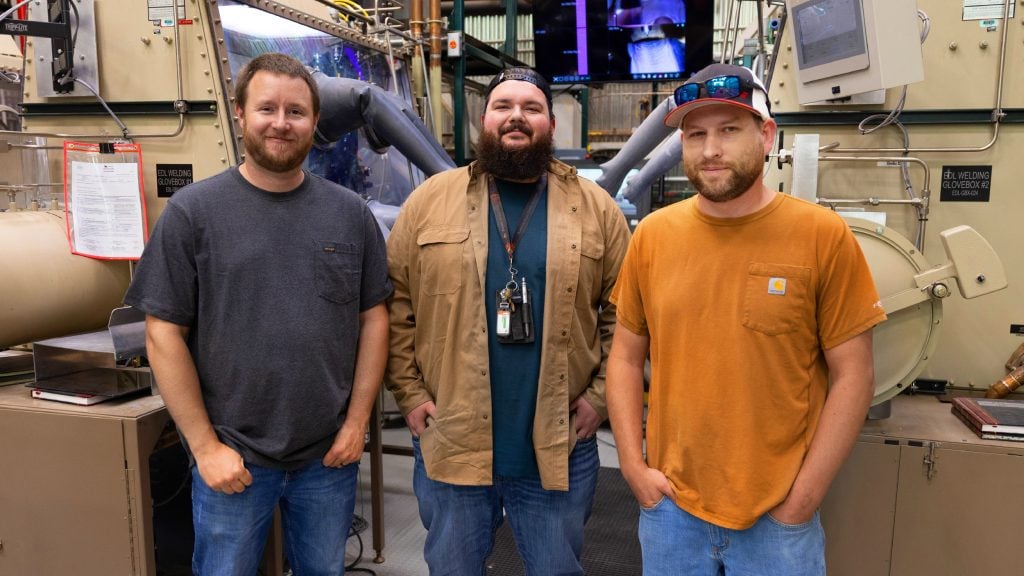
One path to becoming a successful researcher is to find an under explored scientific niche and add knowledge where it didn’t exist before. Gregory Holmbeck, director of the Idaho National Laboratory Center for Radiation Chemistry Research, has found just such a niche by aiming to prove a fundamental concept in radiation science.
Despite being an essential component in industries like nuclear energy, nuclear medicine and isotope production, nonequilibrium, radiation-induced actinide species are not well understood.
Nonequilibrium, radiation-induced species are transitional forms of radioactive elements (like actinides) that change when hit by radiation. These changes can affect how they behave in nuclear systems, like reactors, waste storage, etc.
Think of them as the figurative lightning strikes of nuclear science — powerful, short-lived and only present under specific conditions such as during the intense irradiation of actinides — a group of 15 radioactive elements like uranium, thorium and plutonium. But nobody knows exactly how they behave.
“These are intermediate states we only know exist because in order to get from point A to point C, B must be involved somewhere — so B is what I’m interested in,” said Holmbeck. “Demonstrating their existence and explaining their behavior may seem fairly obvious to some, but if those people could tell me how they work, I’d shut up about it.”
A rare opportunity
Working with actinide elements is difficult. Not only are they radioactive, but many of them are either in short supply or highly regulated, limiting the number of people and facilities that can handle them.
Fortunately, Holmbeck has been awarded a research initiative from the Department of Energy Office of Science Early Career Research Program to investigate their formation mechanisms, lifetime and chemical reactivity. This is only the third award of its kind given to an INL employee.
“When you’re studying chemistry, you learn about the actinides with the understanding that you may never get to see or handle them,” Holmbeck said. “I am very lucky and honored to get to work with these elements at INL, some of which have only been produced in amounts of just a few grams since the 1950s.”
Accessing the necessary tools and materials
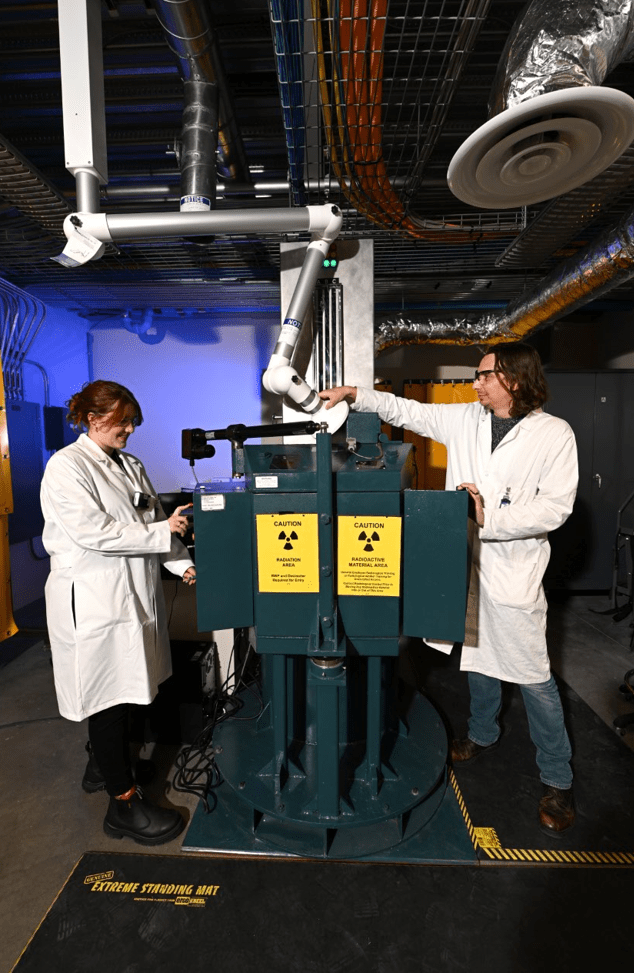
At INL’s Materials and Fuels Complex, Holmbeck has access to a wide range of actinide isotopes in the necessary quantities, and the steady-state irradiation and radiochemistry facilities to observe and analyze them.
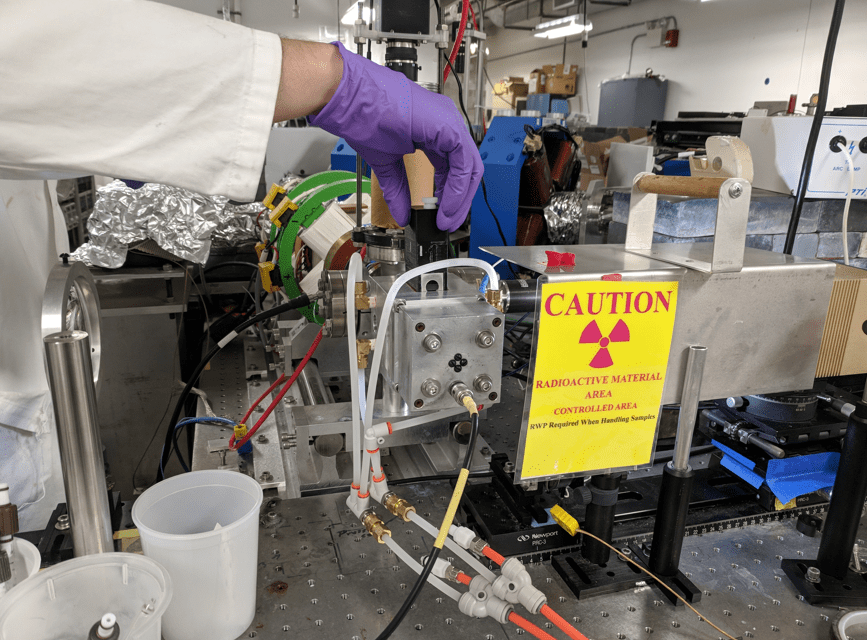
Holmbeck will pair the collected experimental data with advanced computer models that predict the behavior of actinides in radiation environments using INL’s High Performance Computing resources. To validate these predictions, he will collaborate with Brookhaven National Laboratory and the University of Notre Dame Radiation Laboratory to use their pulsed electron accelerators, which will physically create and measure short-lived actinide species.
“Some aspects of my work require these electron accelerators, but there are only a handful of them in the world, and even fewer that allow for experiments with radioactive materials,” said Holmbeck. The collected data will help verify the modeled research findings and guide subsequent experiments.
Widespread benefit
Holmbeck’s program will provide fundamental knowledge that will improve the safety and efficiency of actinide applications.
Take isotope production, for instance, which involves creating radioactive forms of elements for specific uses like nuclear medicine, material analysis, sterilization or nondestructive testing. The elements must undergo highly sophisticated separation techniques to filter out the desired materials.
“To create the most effective isotope recovery system, you need to understand the underlying radiation chemistry, as the targets and desired isotopes are highly radioactive,” said Holmbeck. “This under-the-hood knowledge can help us to recover higher yields of these critical materials.”
In actinide-mediated radiotherapy, used in cancer treatment, it’s essential to ensure that actinides behave predictably. “You don’t want actinides wandering around the human body,” Holmbeck said. “You need to know that they’re being carried to exactly where they’re supposed to be and how the underlying radiation-induced activities can affect this.”

A jumping-off point
Once there is an adequate baseline for radiation-induced actinide chemistry, researchers can explore ways to positively manipulate these processes.
“The idea is that this program will equip people with the tools and the understanding so that they can tailor or mitigate radiolytic processes to fit their need,” Holmbeck said.
Receiving the Early Career Research Program award means Holmbeck and his team will dedicate the next five years to collecting and publishing as much data as possible on non-equilibrium actinide states, using resources from across the country.
“This is an extensive research effort that could receive continued investment in the future, so now our task is to understand the fundamental principles that will provide that baseline,” Holmbeck said.
For more information on radiation chemistry research at INL, visit https://inl.gov/cr2/.