Somewhere over a battlefield, a drone the size of a shoebox is closing in on its target. It cost less than most cell phones and there is no reliable way to stop it.
The ability to stop drone attacks has quickly become a defining challenge of modern warfare. Air Force veteran Spencer Brandon understands the threat firsthand. He’s seen how rapidly drones have changed the battlefield.
As a systems engineer and research pilot for the Uncrewed Air Systems (UAS) program at the Idaho National Laboratory (INL) — a research site sprawling across a swath of east Idaho desert the size of Rhode Island — Brandon is focused on helping close critical gaps in the nation’s counter-UAS capabilities.
From the firing lane to the flight line
Brandon’s path began in Kingsport, Tenn. where he grew up playing with Legos, earning his Eagle Scout rank and joining the rifle team in high school. He had many interests growing up but joining the military wasn’t one of them.
It wasn’t even on his radar, at least not until he travelled to Fort Benning, Georgia to compete in the USA Shooting National Championships his junior year in high school. While there, Brandon struck up a conversation with an assistant coach from the U.S. Air Force Academy’s rifle team. By his senior year of high school, he’d been recruited to shoot for and accepted into the U.S. Air Force Academy in Colorado Springs.
What followed was harder than anything he’d anticipated. The tempo was relentless and included full days of classes, military formations, rifle practice and homework until bedtime — then rinse and repeat.
“It pretty much takes over your whole life,” he said. “It’s a very strict military environment.”
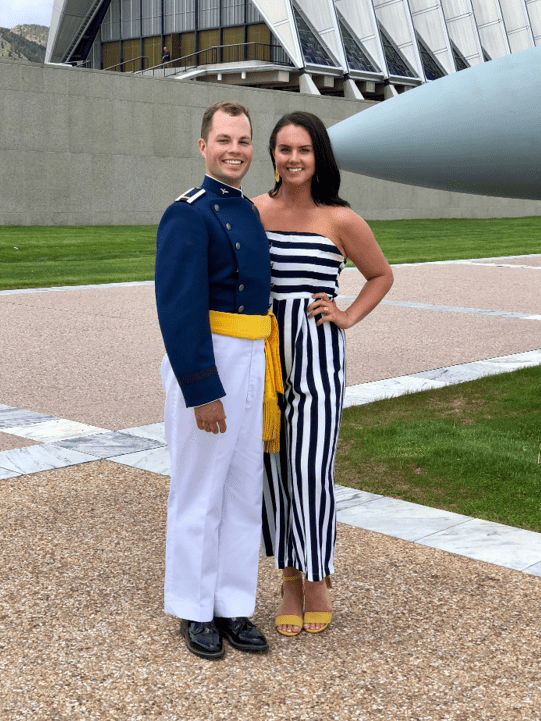
He pushed through and graduated from the Air Force Academy in 2018 with a degree in systems engineering. He went on to pursue an Air Force career in remotely piloted aircraft, a field that was rapidly reshaping military mission spaces.
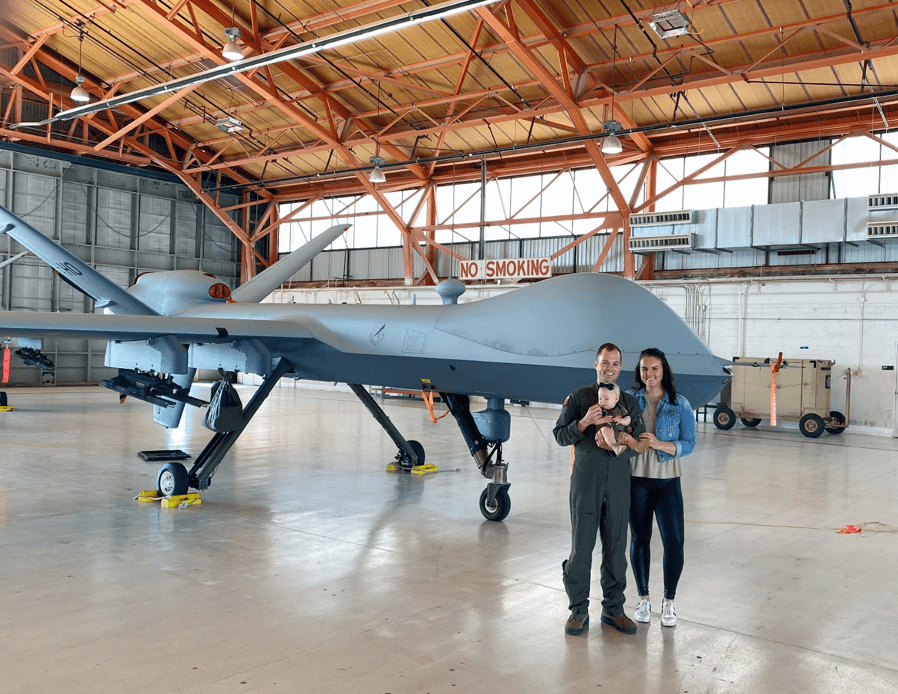
After learning to fly the MQ-9 Reaper at Holloman Air Force Base in New Mexico, Brandon flew real-world missions from places like Ellsworth Air Force Base in South Dakota and Shaw Air Force Base in South Carolina. He was doing meaningful work.
But after more than seven years on active duty, he was ready for a change of pace that would let him stay in the fight and stay in one place. Brandon was ready for something that could provide his family with more stability. After nearly a decade of moves, they were ready to put down roots.
Unexpected runway
The final stretch of Brandon’s military service led him back to Georgia for more life-changing encounters. He attended a career conference in Atlanta aimed at connecting transitioning service members with employers.
There, Brandon connected with several DOE laboratories. He was intrigued by INL, but skeptical that a nuclear lab would have a drone program. He reached out anyway through the Department of War’s SkillBridge program. As a SkillBridge partner, INL is able to help service members build research experience, and shorten the path into civilian research and development careers.
At first, Brandon was open to any role that seemed like a good fit. To his surprise, not only did INL have a drone program — it has some of the most advanced UAS research and testing capabilities anywhere.
After completing SkillBridge and fully transitioning out of the military, INL offered Brandon a full-time position within its UAS program, where his work continues to make a difference — now more than ever.
A new kind of arms race
Brandon had barely settled in when the urgency of his new work came into focus. The same technology he’d spent years flying for the U.S. military had proliferated in the hands of adversaries — cheaply, rapidly and globally.
“If you look at the different conflicts that are happening in the world right now, you’ll see that drones mold the present and future of warfare,” Brandon said.
Drones have become inexpensive, expendable, hard to detect, easy to conceal and increasingly lethal.
“There’s not a human sitting in the aircraft so it’s easy to sacrifice it,” Brandon said. “They’re putting explosives on them, they’re making them one way attack drones, there are all kinds of different creative things we are seeing people around the world in different conflicts use them for.”
The offensive capabilities of UAS have raced ahead of defensive ones.
“We’ve got a lot of drones that can fly very far and do very cool things with different cameras and sensors, but we don’t have anything that’s great at stopping them,” Brandon said. “That’s counter-UAS research, something we’re really focused on at INL.”
Counter-UAS encompasses the detection, tracking, characterization and defeat of hostile drones. It remains a largely unsolved problem in modern defense. And as Army Secretary Dan Driscoll testified before the Senate Armed Services Committee, the threat extends well beyond the battlefield.
“This is the future of, not only warfare, but how humans inflict violence on each other,” Driscoll said. “This is a risk at our stadiums, our arenas, our ports, our borders — not just for our nation but every nation all at once.”
Building the ranges and infrastructure needed to counter that threat is a national priority.
“We’re actively building out those ranges on behalf of the government,” Driscoll said.
The nation needs a place to work on counter-UAS. That place must have the airspace, the infrastructure, the expertise and the freedom to find system limitations and then push past their breaking point.
It turns out that place already exists at INL.
Closing the gap
For Brandon, integration is a big part of why he’s at INL.
At INL, Brandon works in one of the few places in the country where the airspace, infrastructure and technical expertise exist together at scale to push counter-UAS systems to their limits under realistic conditions. The work draws on everything he has experienced along the way — the systems engineering mindset he developed at the Air Force Academy, the operational realities he learned flying MQ-9 missions and the urgency of a threat evolving faster than most defenses can keep up.
And the stakes extend far beyond the battlefield.
The same technologies reshaping warfare are also forcing governments to rethink how they protect critical infrastructure, military installations, borders and public spaces. Adversaries are not waiting for defenses to catch up. Drone technology is becoming cheaper, more capable and more widespread every year.
For Brandon, it’s the reason counter-UAS work matters.
“The work we do will ultimately equip our nation and our allies with better aircraft, equipment and sensors,” he said. “It will keep our nation safe.”
As the country positions itself to prioritize drone defense, counter-UAS work is already underway in a place largely unknown to the public it serves, the Idaho National Laboratory.
Learn more about INL’s UAS program here.
The right place, at the right time
From the outside, INL is known as the nation’s premier nuclear energy laboratory — the birthplace of nuclear energy and a place where new and advanced reactor concepts are being developed, tested and validated. That reputation is well-earned.
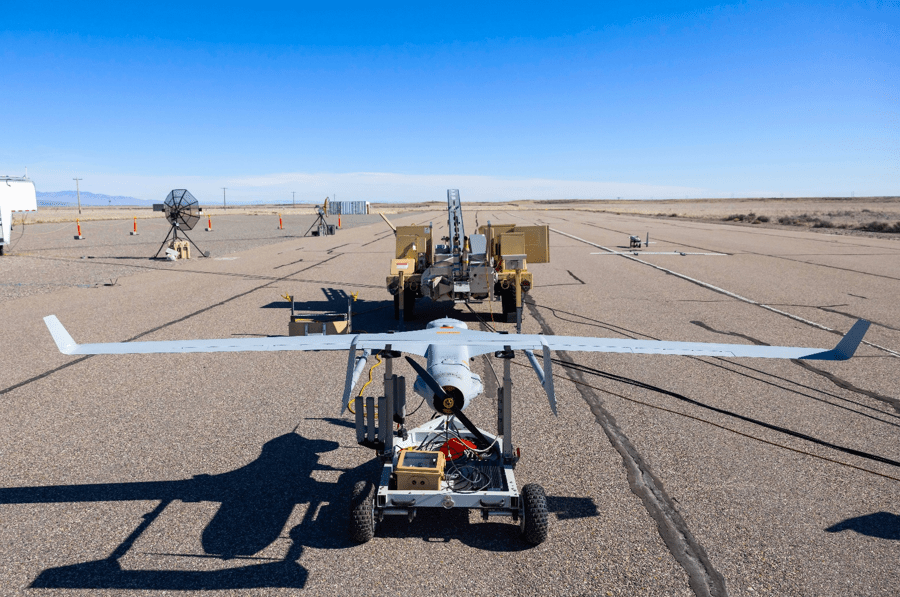
But its 890-square-mile site in the eastern Idaho desert is also home to one of the most capable UAS research, development, testing and evaluation environments in the country.
Since 2012, INL’s UAS team has supported more than 40 types of unmanned aerial systems, ranging from under 1 pound to nearly 600 pounds, operating from a 1,000-foot runway and an environmentally controlled support facility. The laboratory’s blanket FAA Certificate of Authorization covers sub-55-pound UAS platforms up to 9,500 feet mean sea level, enabling realistic evaluation across complex operational scenarios — including GPS-denied operations coordinated with the Department of Energy. More than 8,000 square miles of federally authorized airspace sit above the site.
The terrain is isolated and federally controlled. It’s far from population centers and electromagnetic interference. Yet it’s customizable and representative of real-world operational conditions that include explosives, power, and radiological test ranges; extreme temperatures, severe weather and rough terrain; and congested, contested or long-distance communication challenges.
In fact, a state-of-the-art wireless test bed spans the site, which is positioned within a natural caldera that enables seamless tower handoffs across a 400-square-mile 5G coverage area overlapping 800 square miles of restricted airspace. INL’s experimental radio station status with the National Telecommunications and Information Administration (NTIA) allows operation across nearly the complete radio frequency spectrum — from 31 Hz to 10 GHz — enabling testing across 2G through 5G cellular networks, WiMax, Wi-Fi, Zigbee, Bluetooth and tier-1 carrier networks in congested and contested spectrum environments.
For nearly 30 years, INL researchers have developed, tested and deployed sensors including radiation detection and mapping systems, infrared and hyperspectral cameras, real-time image analysis tools, air sampling devices and high-bandwidth encrypted communication systems. The lab also maintains a 40-square-mile kinetic UAS and counter-UAS range capable of explosives testing, supporting inert one-way attack UAS evaluation, integrated detection and defeat systems and radar and RF “dark” threat assessments.
The capability is real. The question is whether the country can leverage it in the defense-versus-offense UAS arms race.
At the end of the day, what distinguishes INL from other testing environments isn’t any single capability — it’s the integration of all of them, at-scale, all in one place.