
Nuclear Fusion Modeling and Simulation
Powerful computer models help scientists explore how fusion works and design reactors faster, safer and more efficiently.

Modeling and Simulation for Fusion Systems
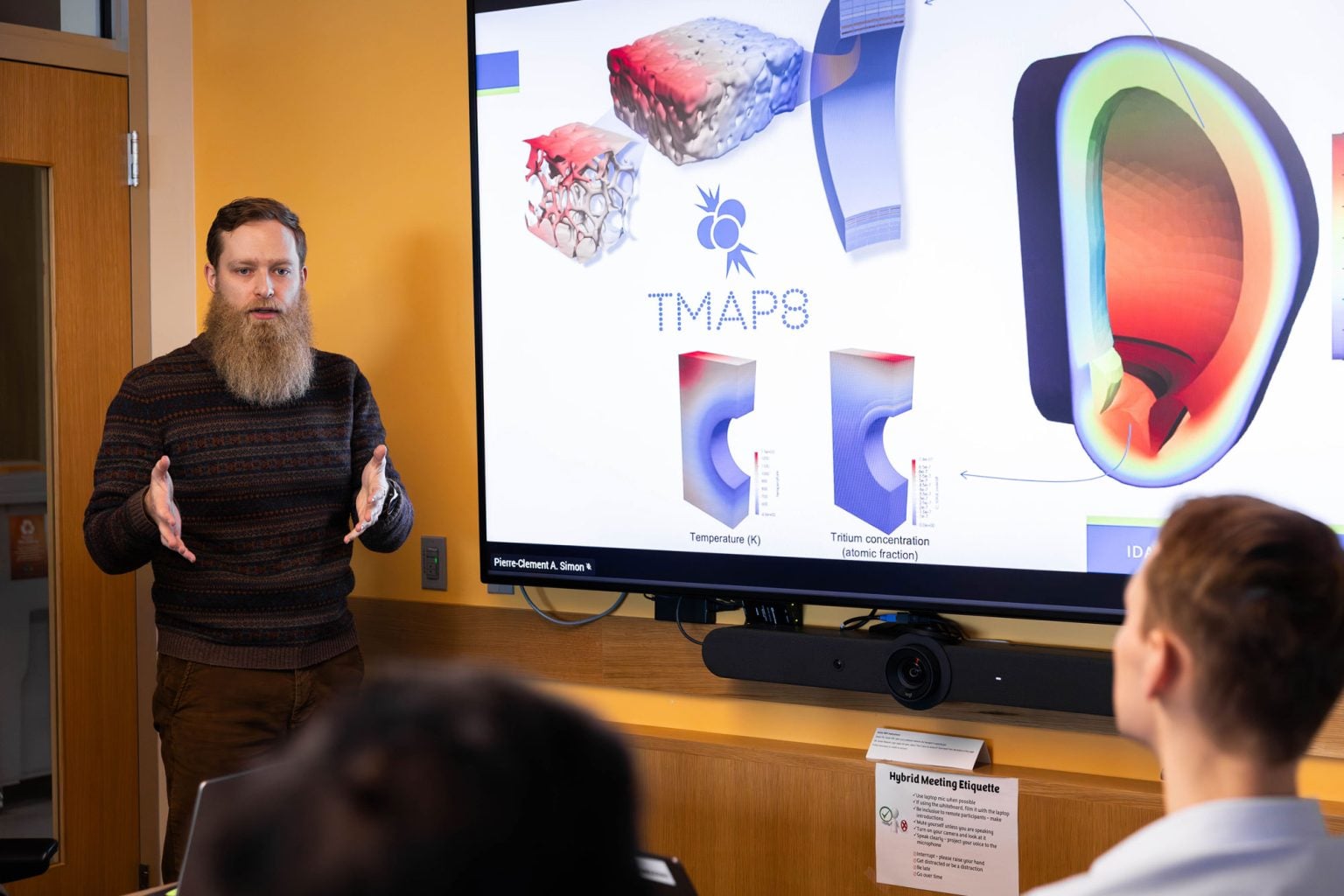
To make nuclear fusion work, scientists use high-performance computing to create models and simulations. These tools help researchers understand what happens inside fusion reactors. Based on that understanding, they will test different designs and find the best ones without needing to build them first.
Why Computing?
Computing is essential to advancing fusion energy because it allows scientists to simulate the complex physics inside a reactor before it is built. High-performance models can capture interactions between plasma, materials and systems, helping researchers predict behavior, evaluate designs and reduce technical risk.
Computers can simulate the complex interactions that occur inside a fusion reactor. They help scientists predict how plasma (an ionized gas composed of ions and electrons) will behave. These simulations save time and money that could be used to build and test real-world reactors.
Fusion blankets, like those being developed as part of a DOE initiative, and other plasma-facing parts must withstand extreme heat and radiation. Advanced simulations help design materials that can survive these conditions.
Relevant Applications
These modeling tools provide the foundation for understanding and designing fusion energy systems. By simulating complex physical processes—from plasma behavior to tritium transport and system safety—these applications enable researchers to evaluate performance, reduce risk and accelerate the development of reliable fusion technologies.
MELCOR for Fusion
Primary Contact: Adriaan Riet
A modified version of the MELCOR code is under development at Sandia National Laboratories in New Mexico for the U.S. Nuclear Regulatory Commission. This fully integrated, engineering level thermal-hydraulics computer code models the progression of accidents in fusion power plants, including a spectrum of such accident phenomena as loss-of-cooling and loss-of-vacuum accidents, which can result in the release of radioactive materials (e.g., activation products and tritium). MELCOR contains models describing reactor cooling system and containment fluid flow, heat transfer, and aerosol transport.
MELCOR has been used for accident analysis in ITER’s preliminary safety-analysis reports and the Advanced Research on Integrated Energy Systems (ARIES) Design Team safety analyses.
Tritium Migration Analysis Program (TMAP)
The Tritium Migration Analysis Program (TMAP) treats multispecies surface absorption and diffusion in composite materials with dislocation traps, plus the movement of these species from room to room by airflow within a given facility. Most recently, TMAP (within TMAP8, below) has been expanded to include many multiphysics, multiscale capabilities relevant to component design for blanket systems and within complex geometries.
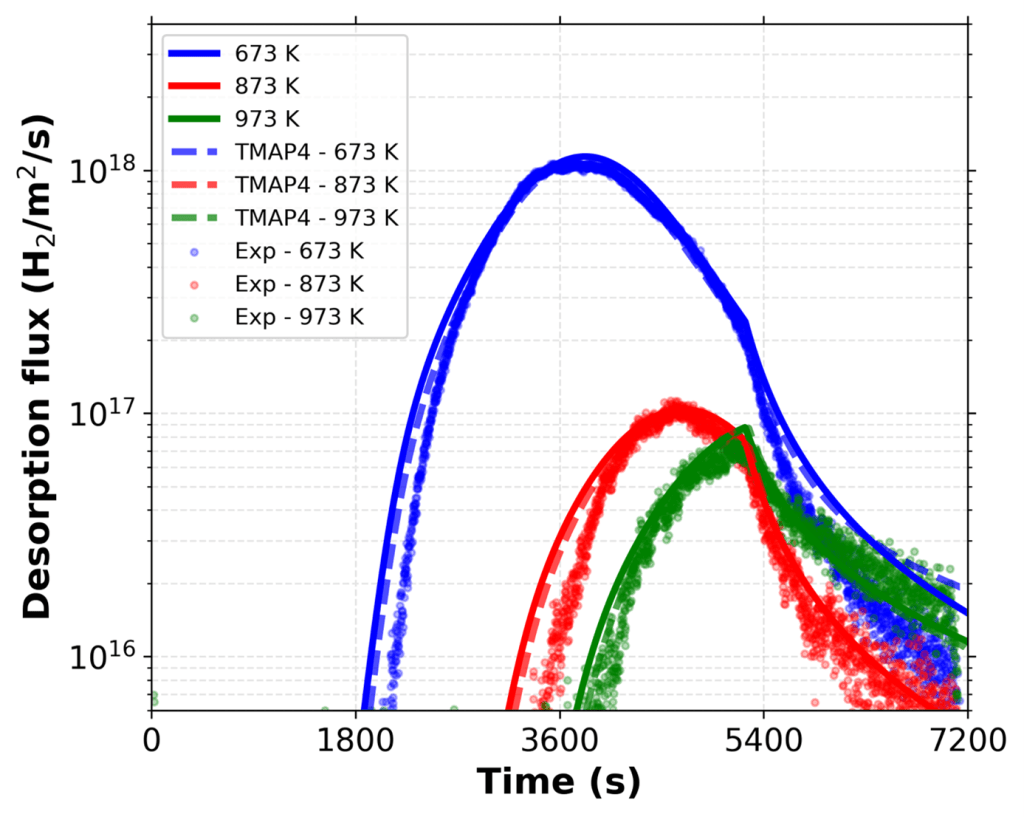
The number of TMAP users is unknown, but it has been listed as the third most-requested code from DOE’s Energy Science and Technology Software Center (ESTSC) website. The figure shows a TMAP8 code application to the thermal desorption spectrum of a neutron-damaged sample of tungsten after being exposed to a deuterium plasma. TMAP8 results here are also compared to TMAP4.
TMAP8 is open source and available on GitHub. The detailed instructions for installation and first use are available on the TMAP8 website. TMAP8 is a MOOSE-based application that provides state-of-the-art tritium transport and fuel-cycle modeling capabilities. TMAP8 aims to expand the capabilities of previous versions (i.e., TMAP4 and TMAP7) by leveraging modern computational techniques, ensuring high software quality assurance standards — key to building trust — and enabling multispecies, multiscale (mesoscale, component-level, and system-level) and multiphysics simulations for integrated tritium-transport modeling in complex geometries.
TMAP4 and TMAP7 are available from ESTSC or by contacting INL’s Technology Deployment Office.
SALAMANDER
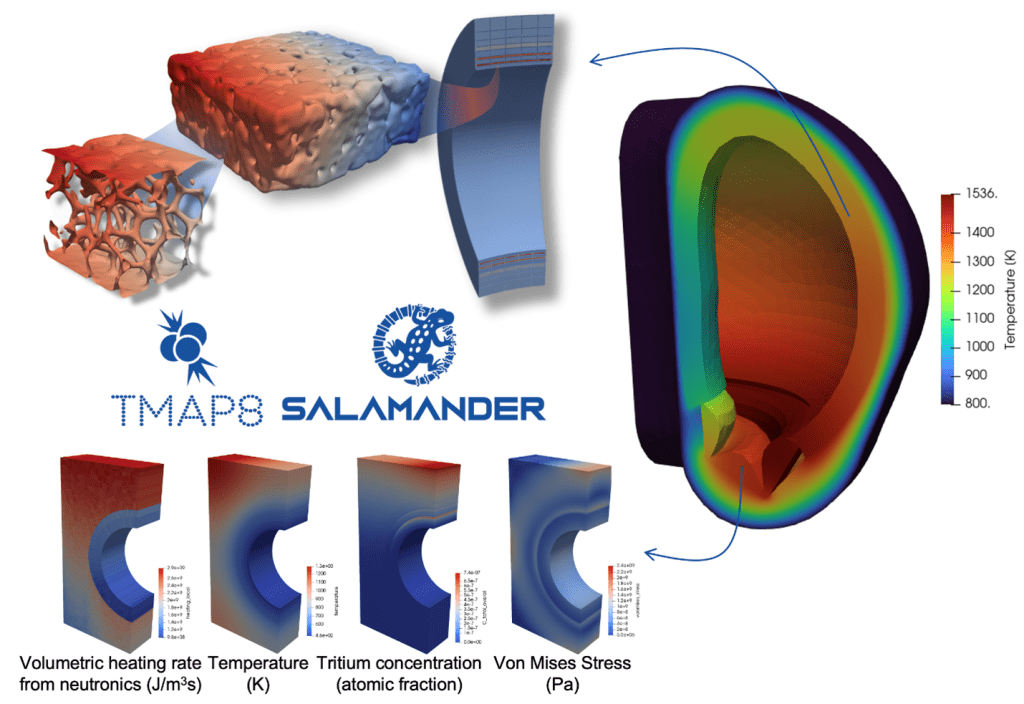
The Software for Advanced Large-scale Analysis of Magnetic Confinement for Numerical Design, Engineering & Research (SALAMANDER) is being developed as a MOOSE-based open-source, fully integrated multiscale application facilitating high-fidelity 3D modeling of fusion systems. It is available on GitHub, and the detailed instructions for installation and first use are available on the SALAMANDER website. SALAMANDER couples thermal hydraulics, heat conduction, thermomechanics, tritium transport via TMAP8, neutronics via Cardinal, and nascent particle-in-cell capabilities. Direct-simulation Monte Carlo methods are used to address neutral transport near the walls. By coupling these physics in an integrated application, SALAMANDER enables high-fidelity modeling of irradiation levels and plasma exposure conditions and their impact on heat and tritium distributions, as well as the resulting mechanical constraints experienced by fusion components. Furthermore, SALAMANDER is particularly suited for engineering studies thanks to the stochastic tools module readily available in MOOSE.
MAGARC
Primary Contact: Casey Icenhour
With a name that is a portmanteau of “magnet arcing,” MAGARC couples electromagnetics, radiant-energy transport, and heat-conduction code to analyze magnet arcing and quenching accidents. It was employed in 1999 through approximately 2016 as part of the ITER magnet-safety assessment and engineering-design activity through a collaboration with the ITER organization. It was also used for the early design of DEMO. MAGARC capabilities are currently under reconstruction to be reformulated within the MOOSE framework.
MSCAP
Primary Contact: Casey Icenhour
The Magnetic System Circuitry Analysis Program (MSCAP) is a power systems safety analysis code that simulates normal and off-normal electrical events in the power delivery systems of superconducting magnets in magnetic confinement systems. It was used within the ARIES and Compact Ignition Tokamak design studies and is integrated into the MAGnet System (MAGS) code developed by Karlsruhe Institute of Technology to study magnet quenching. Through MAGS, MSCAP was used as part of the ITER safety basis (specifically, the toroidal field coil project in the 1990s and 2000s). MSCAP is currently available by request, though no longer under active development. It is under evaluation to be updated within the MOOSE ecosystem.