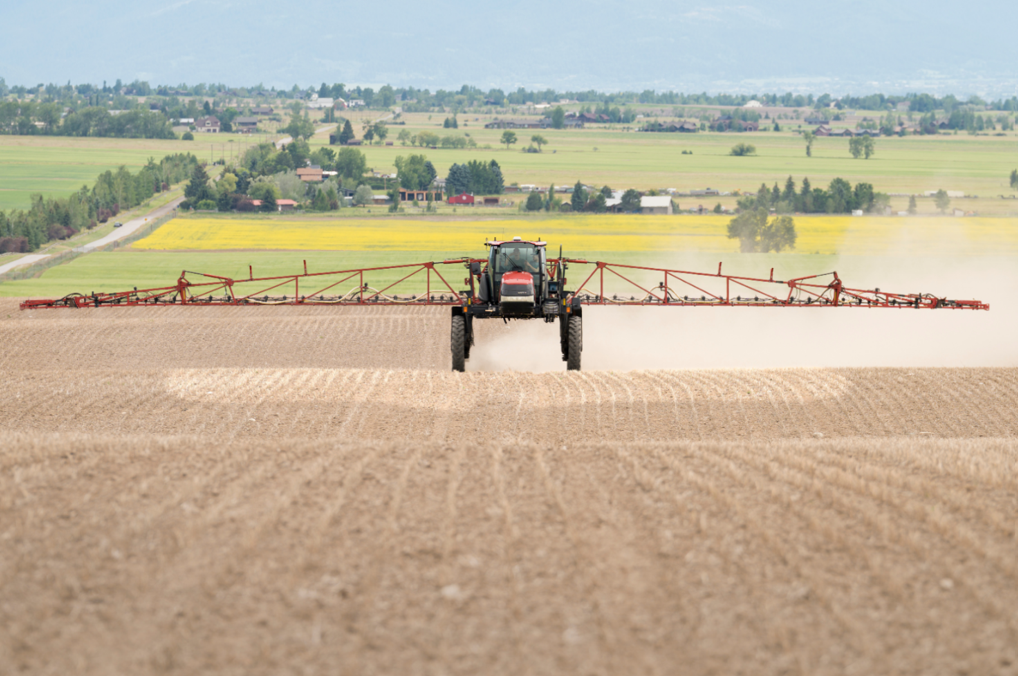
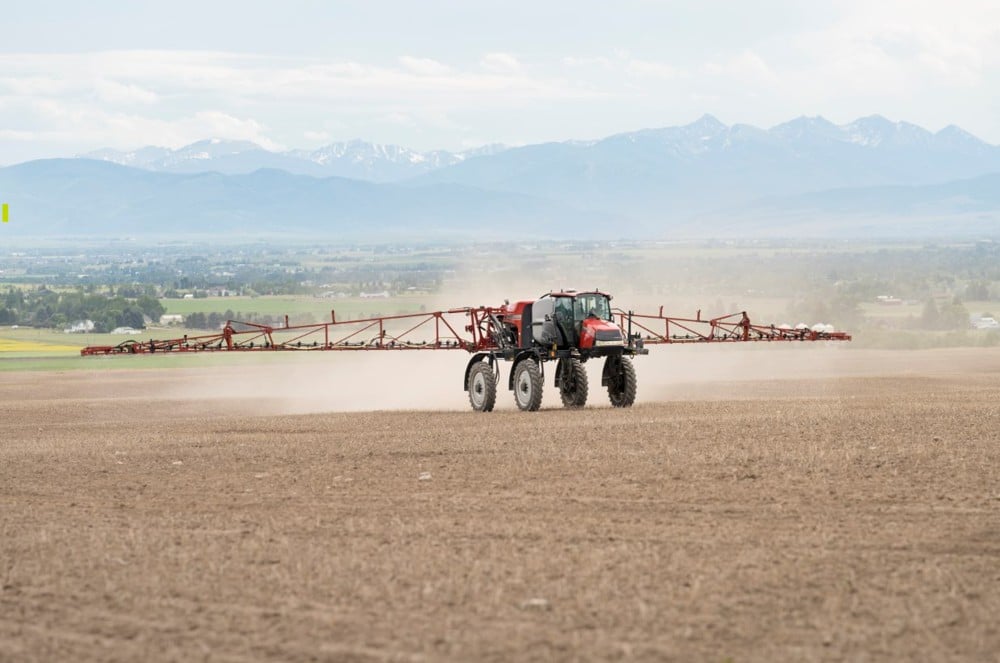
It is July, and Montana farmers are testing software from the Idaho National Laboratory (INL) on a tractor’s autosteer operating system. The software uses field data to tell a tractor where to travel for the most efficient drive path. Then, the tractor pulls a 90-foot-long agricultural sprayer that covers large swaths of a field with liquids such as fertilizers, herbicides and fungicides.
Farmers who plan their drive paths typically use a basic GPS — great for drawing straight lines, but less effective for irregular field shapes and other complexities. Farmers could use fertilizer, fuel and other resources more efficiently — saving both time and money — if they could chart smarter drive paths.
The software tested in Montana this summer offers a solution. Called FieldSim, this software was developed by INL systems scientist Lionel Toba to make calculations about growing bioenergy crops on low-value land. It turns out that this same software can be used to calculate field efficiency for farmers.
Seeing this potential, INL made FieldSim available for licensing. Two entrepreneurs are now developing FieldSim as a commercial product in partnership with Montana State University. This success story shows how lab-developed software can make its journey into the commercial market.
“FieldSim moving from a research tool into commercial use is incredibly rewarding,” Toba said. “This is technology transfer at its best: turning years of research into tools that make a tangible difference in the field.”
From lab to startup
Six months ago, FieldSim was only software with a business plan. New Jersey startup founder Joe Entelisano and Pennsylvania Ph.D. student Waku Ken-Opurum won second place for their FieldSim business plan in the 2025 DOE Boost competition. DOE Boost matches entrepreneurs to technology and software developed at the U.S. Department of Energy (DOE) national laboratories. Entrepreneurs commit to 20 hours a week for several months of workshops and industry discovery to work toward commercializing their technology.
DOE Boost matched Entelisano and Ken-Opurum with FieldSim, one of their top three choices out of ten technology options. Entelisano was new to agriculture but had prior entrepreneurial experience in transportation and supply chains, including route planning and optimization.
“Farmers and truck drivers have similar needs,” Entelisano said. “Both operate in narrow-margin environments and are looking for any way to reduce fuel costs.”
Developing a customer base
From there, the two entrepreneurs attended DOE Boost’s weekly, online workshop sessions, learning about the licensing process and what it takes to start up a company. They held side meetings with FieldSim software developer Lionel Toba so they could learn more to develop their product. Then, as part of DOE Boost’s customer discovery, they attended conferences and learned from as many farmers as possible.
“A large row crop farmer in Iowa is different than a citrus farmer in Georgia or an asparagus farmer in California,” Entelisano said. “In California, farmers care about robotics orchestration and specialty crops. In Nebraska, farmers care about data operability.”
In Montana, there is more total farmland than any other U.S. state except Texas. However, unlike the flat cropland in Iowa and other Midwest states, Montana has a lot of hilly and jagged landscapes. These irregularly shaped fields make it especially important to optimize drive paths, making Montana farmers good potential customers for FieldSim.
Finding commercial partners
In their efforts to develop their customer base, Entelisano and Ken-Opurum connected with Headwaters Tech Hub (Montana’s technology consortium) and Montana State University’s precision agriculture program. The U.S. Economic Development Administration, which funds Montana State University, saw potential in FieldSim and gave the entrepreneurs a $19,000 grant to support their efforts.
“Headwaters Tech Hub has played a crucial role in connecting us with funding sources, experts, and collaborative networks,” Ken-Opurum said. “The organization is dedicated to supporting our growth and success in Montana and even beyond.”
The university made a formal plan to co-develop FieldSim, testing it in July on real farm equipment at Lutz Farm, a 600-acre research test bed near Bozeman, and giving the entrepreneurs access to their grower network for continued feedback. Entelisano and Ken-Opurum said they hope this first target market in Montana will give them a strong foundation from which to build and expand their customer base.
Bioenergy beginnings
When Toba, an INL systems scientist, originally developed FieldSim in 2021, it was for bioenergy crops, part of a project funded by the U.S. Department of Energy’s Alternative Fuels and Feedstocks Office. INL researchers needed software they could use to calculate how the overall cost and operability of a field changes when low-productivity crop areas are replaced with crops that can be harvested and used to produce biofuel. These bioenergy crops offer greater income potential for farmers while being a source of alternative fuel.
There isn’t a market yet for growing and selling dedicated bioenergy crops. However, there was commercial potential for FieldSim to help farmers who raise conventional crops. Ryan Bills, a commercialization manager from INL’s Technology Deployment team, noticed this potential. After researchers used the software for its original purpose, Bills worked with Toba to make the software available for licensing outside of the lab. Toba also participated in INL’s Energy I-Corps Lite, a condensed training program to help laboratory researchers explore and develop viable market pathways for their technologies. Bills later selected FieldSim as a technology that could be matched with entrepreneurs at DOE Boost.
After Entelisano and Ken-Opurum were paired with FieldSim, they executed an exclusive, exploratory research and development license with INL to do their customer discovery and development work. The exclusivity will help protect their investment in advancing the software and help them secure additional funding to build their business. Next, they plan to purchase an exclusive commercial license.
What’s next
There are 900 million acres of farmland across the United States, showing a large potential market for FieldSim. From the pilot-stage work this summer, Entelisano, Ken-Opurum and Montana State University plan to continue soliciting customer-base feedback as they prepare FieldSim for its first commercial sales. They hope to onboard their first customers of about five to 10 Montana farms by the end of the year. Read more about FieldSim.
Entrepreneurs interested in licensing INL software or technology can visit INL’s Technology Deployment site.