
Central Facilities Area
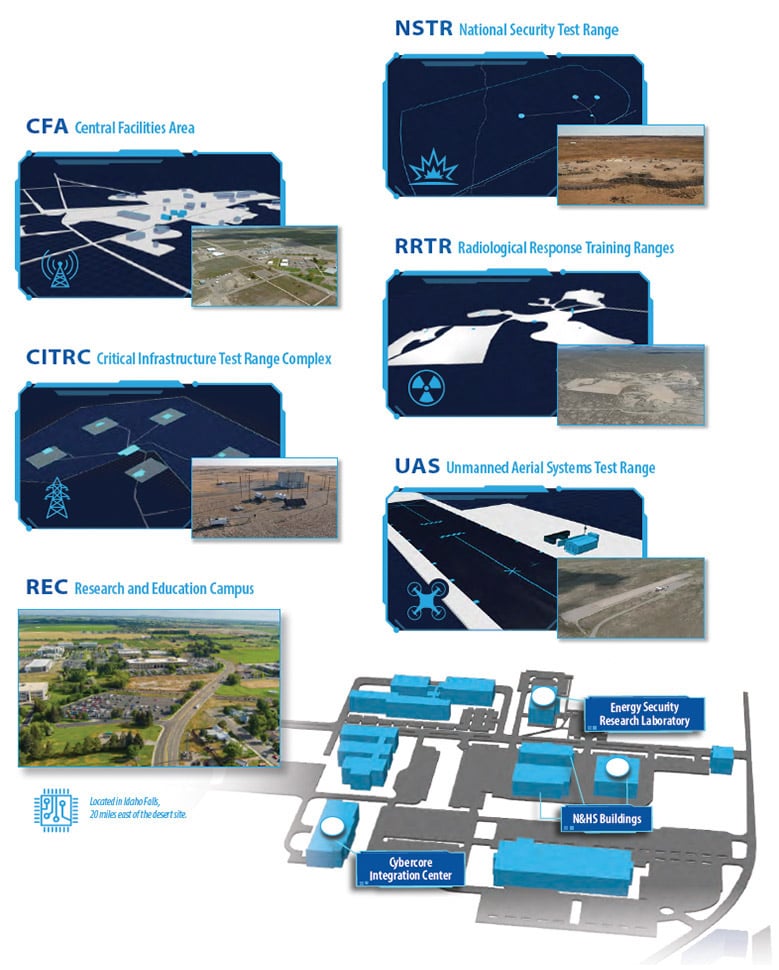
The Central Facilities Area (CFA) supports the Wireless Test Bed network and operations center. It also includes several sitewide support services for protection, emergency response (INL Fire Department), network and communications, transportation (INL bus depot), and warehouse services for the various Site campuses.
National Security Test Range
The National Security Test Range (NSTR) complex consists of eight indoor and outdoor ranges, and tactical training facilities located on 330 acres of isolated, desert-type terrain. The facilities support research and development testing and training and testing of handguns, rifles and heavy weapons such as machine guns, precision rifles, grenade launchers and shoulder-fired, anti-armor weapons. Explosive training and testing, including breaching, is also conducted.
National Security Test Range provides access to capabilities to understand and mitigate emerging challenges being faced on the battlefield.
- 8-km range fan
- Classified testing capability
- Tactical breaching training
- Classified networking
- Dynamic testing experience
Critical Infrastructure Test Range Complex
Critical Infrastructure Test Range Complex (CITRC) houses several former nuclear facilities that have been repurposed for national security testing and training. As home to INL’s Power Grid Test Bed there is commercial-grade substation, Raghorn transmission line, and several associated test pads and laydown areas used for experimental power grid testing and training.
Several of decommissioned experimental nuclear reactors also support radiological search and response training and counterproliferation activities. Various classrooms, office buildings, and storage containers complete the complex.
Radiological Response Training Ranges
The laboratory’s 890-square-mile site can be used for large scale interagency technology 13-GA50222-03 and capability demonstrations. Students also have access to nuclear facilities including operating reactors, hot cells, and analytical laboratories inside a controlled location that provides a safe and secure environment for training.
- INL has conducted RDD and WMD classroom and field training since 2002.
- Participants have controlled access to live radioactive materials including sealed sources, fissile materials, and spent nuclear fuels.
- INL’s 890-square-mile site, nuclear infrastructure, and staff expertise are ideal for conducting detection, identification, measurement, and recovery exercises.
- The laboratory has provided source material and expertise to agencies wishing to conduct training at their facilities.
- INL’s site has been utilized for several radiological joint capability and technology demonstrations.
Unmanned Aerial Systems
With its access-controlled boundary, high-desert terrain and sparse population, INL’s desert site is in a unique position to offer unmanned aerial vehicle and unmanned ground vehicle collaborative operational testing and demonstration. INL’s Unmanned Aerial Systems (UAS) program focuses on unique applications and missions for a wide variety of customers looking for affordable, field-deployable airframe technologies with meaningful payload and endurance. The lab’s UAS training is designed to ensure that unmanned aerial vehicles are used properly throughout the Department of Energy and its National Nuclear Security Administration. The range also supports implementation of new legislation regarding protection of critical infrastructure.
Research and Education Campus
REC is in Idaho Falls and offers many of the in-town laboratories and offices for INL staff and researchers. It houses several national security facilities to include: Cybercore Integration Center, Energy Security Research Lab, Security Systems Lab, Cybersecurity and Intelligence, Critical Infrastructure Protection and Resilience, and Homeland Protection. It also offers INL meeting Center with large and smaller meeting, reception and event space.
Energy Security Research Laboratory
The Energy Security Research Laboratory (ESRL) is home to the Controls Laboratory and Wireless Communications Research. The Controls Lab test the effects of kinetic cyber-physical attacks. and allows users to perform security research on industrial control systems (ICS) and supervisory control and data acquisition (SCADA) systems found across multiple infrastructure processes.
Energy Security Research Laboratory
The Energy Security Research Laboratory (ESRL) is home to the Controls Laboratory and Wireless Communications Research. The Controls Lab test the effects of kinetic cyber-physical attacks. and allows users to perform security research on industrial control systems (ICS) and supervisory control and data acquisition (SCADA) systems found across multiple infrastructure processes.
National Security Buildings
INL has several reconfigurable energy security labs for testing and analyzing electronics, industrial control systems and other relevant technology like programmable logic controllers, remote terminal units, digital relays and energy management systems. The lab employees have dedicated expertise in operational technology cybersecurity, power systems engineering and vulnerability analysis. The lab’s test beds can be connected directly to INL’s power grid, creating a full-scale test and evaluation environment.
National Security Buildings
INL has several reconfigurable energy security labs for testing and analyzing electronics, industrial control systems and other relevant technology like programmable logic controllers, remote terminal units, digital relays and energy management systems. The lab employees have dedicated expertise in operational technology cybersecurity, power systems engineering and vulnerability analysis. The lab’s test beds can be connected directly to INL’s power grid, creating a full-scale test and evaluation environment.
Cybercore Integration Center
As a world leader in control systems cybersecurity, INL has more than 100,000 square feet of laboratory and electronics testing space for analyzing and testing operational technology such as industrial control systems and other relevant technology including programmable logic controllers, remote terminal units, digital relays and energy management systems.
Cybercore Integration Center
As a world leader in control systems cybersecurity, INL has more than 100,000 square feet of laboratory and electronics testing space for analyzing and testing operational technology such as industrial control systems and other relevant technology including programmable logic controllers, remote terminal units, digital relays and energy management systems.